864uweeViewNews Object
(
[_rendered:protected] => 1
[_classes:protected] => Array
(
[0] => view-block
[1] => block--spotlight-robust-news
)
[_finalHTML:protected] => https://hedy.ece.uw.edu/spotlight/yiyue-luo-developing-intelligent-wearable-technology-for-healthcare-robotics-and-human-computer-interaction/
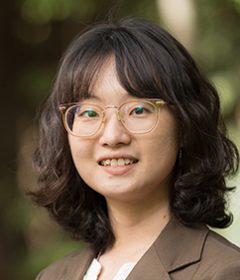
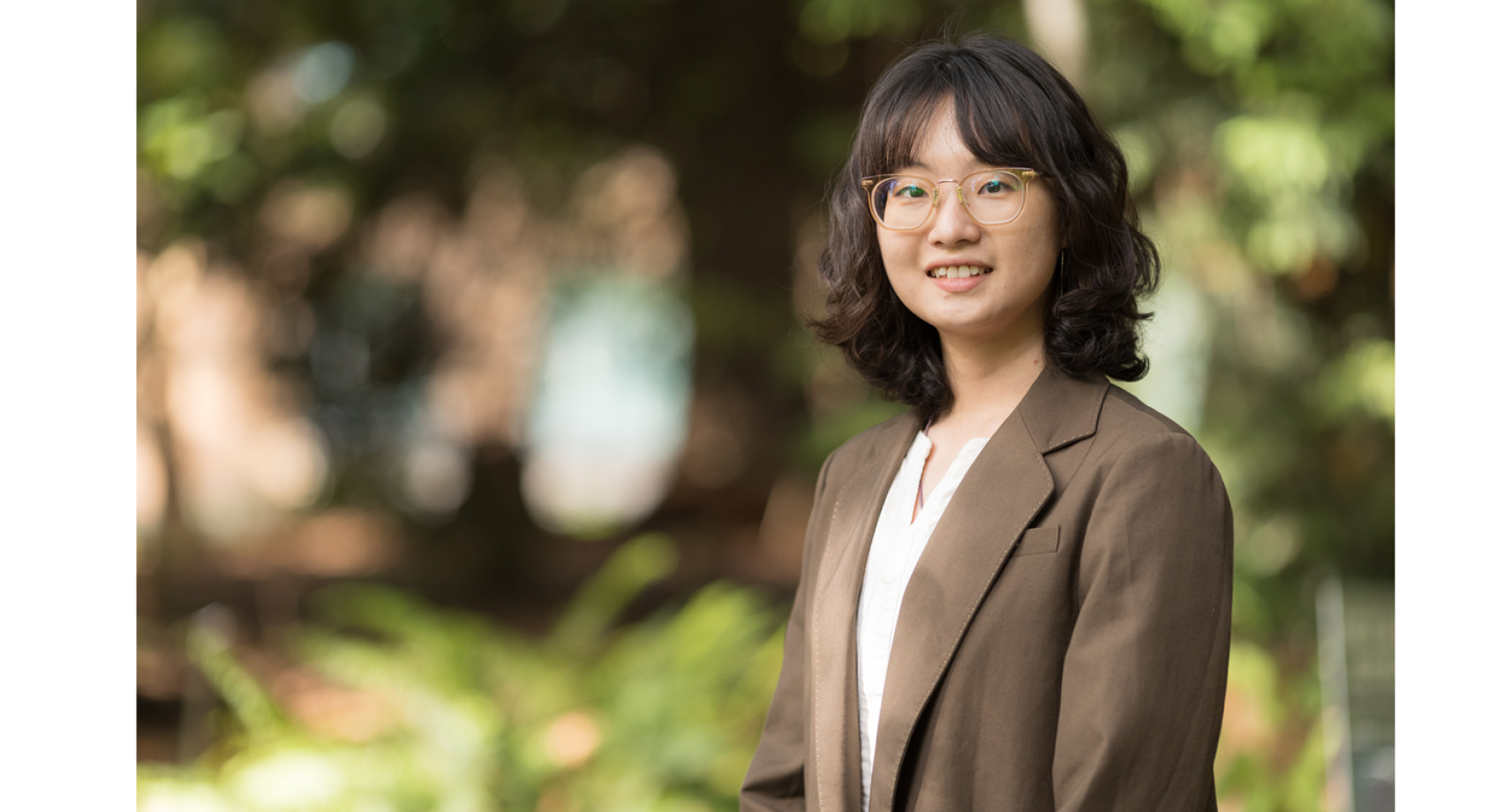
UW ECE Assistant Professor Yiyue Luo is known for her work in intelligent, or “smart,” textiles. At UW ECE, she and her students are expanding this relatively new line of research into other forms of intelligent wearable technology.
https://hedy.ece.uw.edu/spotlight/malek-itani-2026-marconi-award/

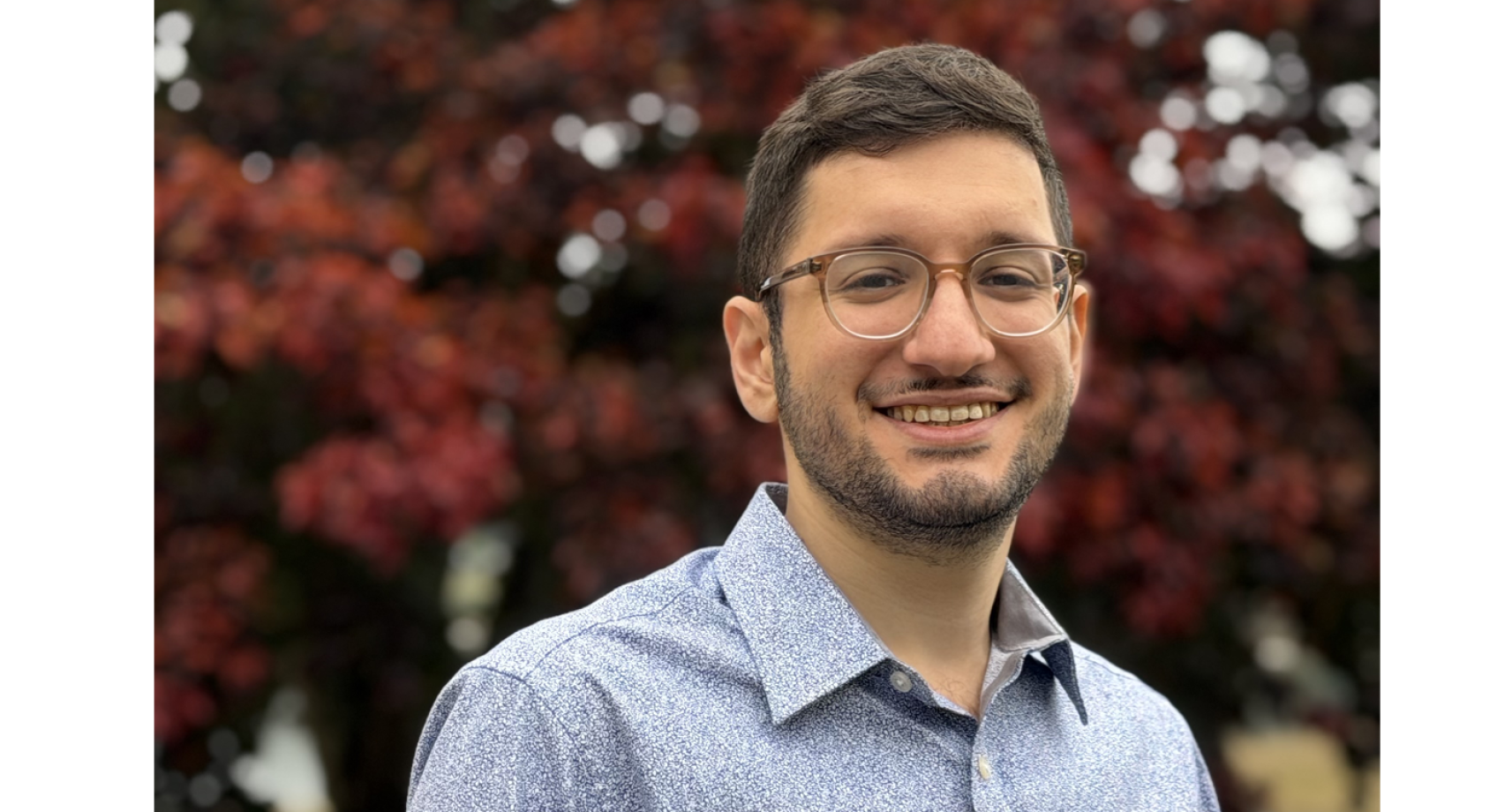
UW ECE doctoral student Malek Itani is being recognized for exceptional early-career research that is advancing the future of information and communication technology.
https://hedy.ece.uw.edu/spotlight/uw-ece-hossein-naghavi-genesis-mission/
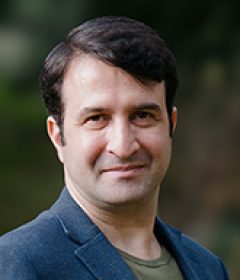
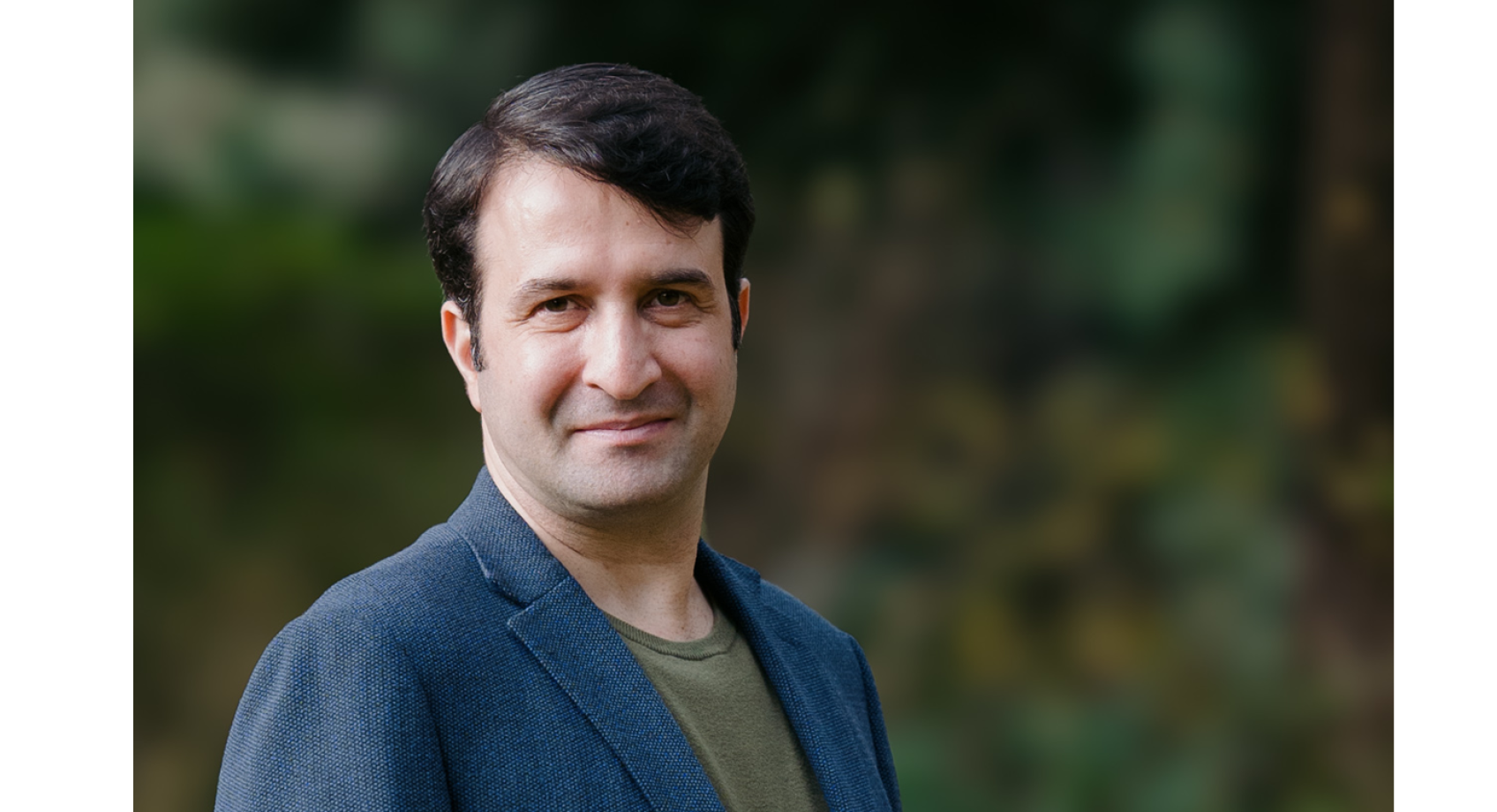
UW ECE Assistant Professor Hossein Naghavi is leading a research project selected for the U.S. Department of Energy’s Genesis Mission, a historic national initiative aimed at building the world’s most powerful integrated science discovery platform.
https://www.upwards.uw.edu/uw-introduces-virtual-reality-training-for-students-to-help-fill-crucial-semiconductor-jobs/
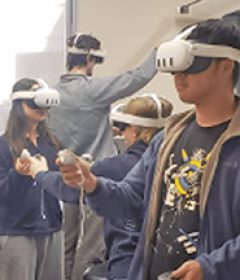
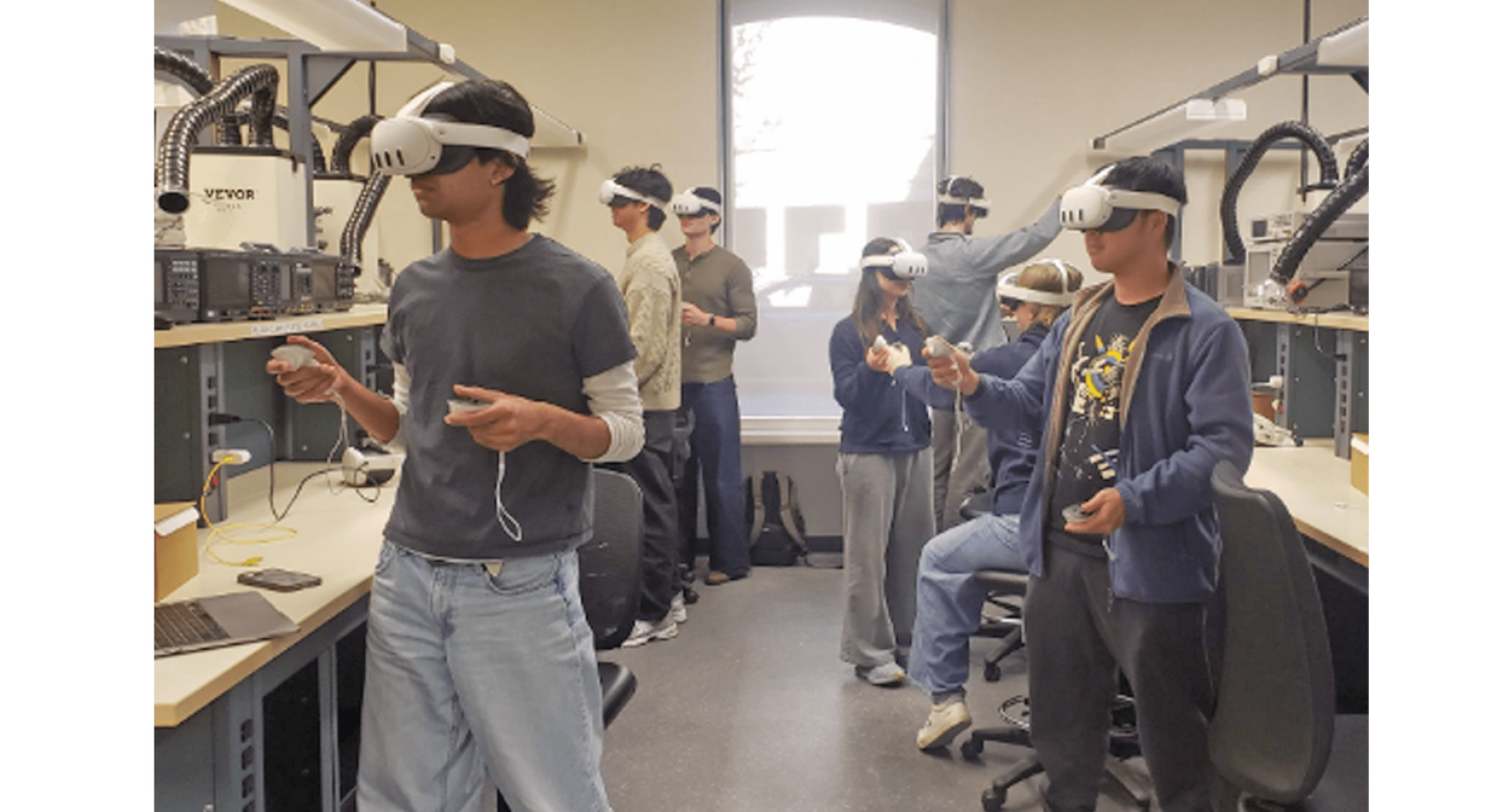
Through a new virtual reality training platform, UW ECE students are gaining immersive cleanroom experience before entering the Washington Nanofabrication Facility for hands-on lab work.
https://www.engr.washington.edu/news/article/2026-07-06/elevating-emerging-engineers
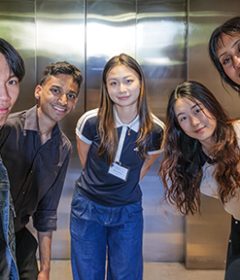
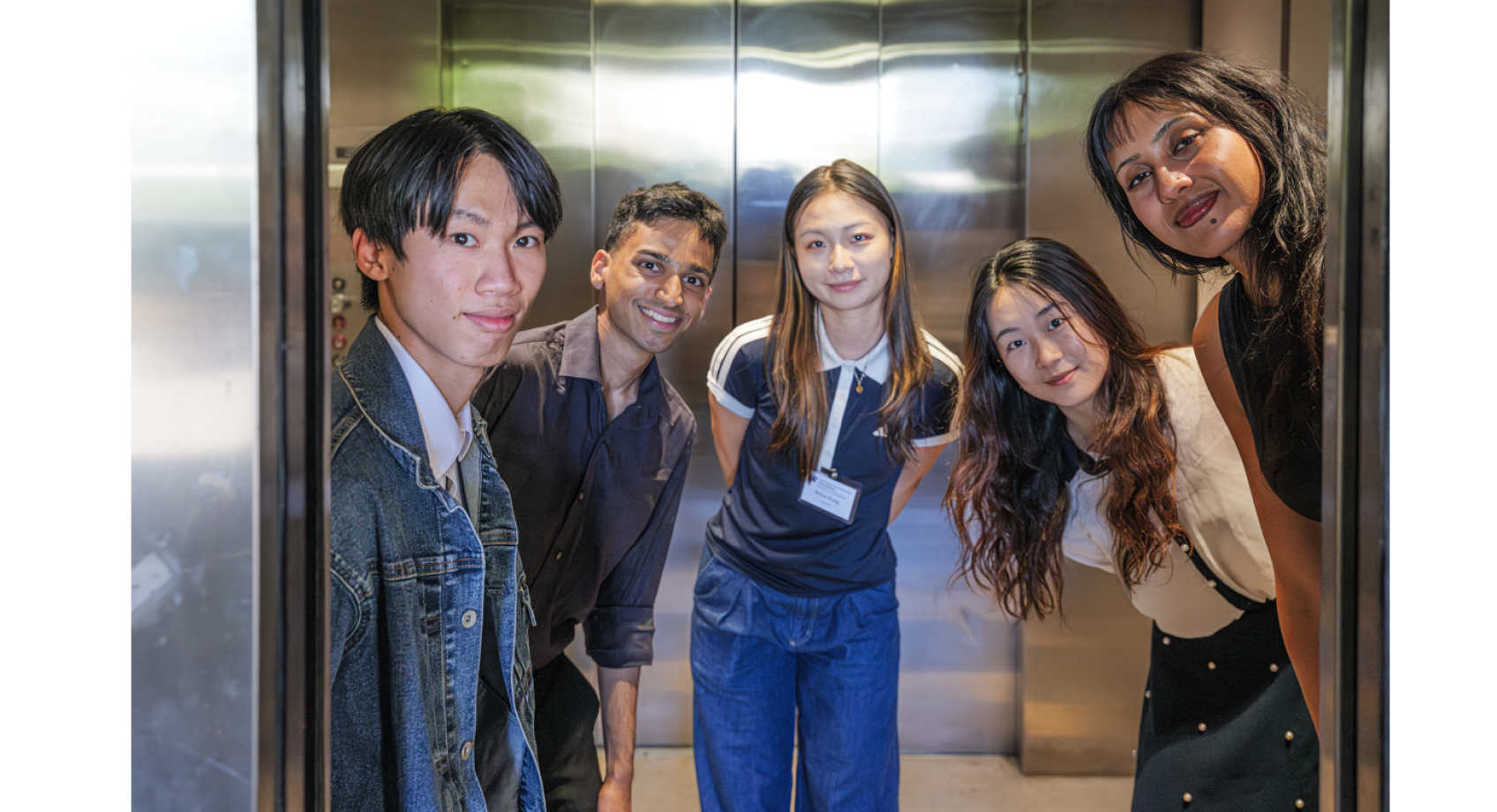
The UW College of Engineering's Industry Capstone Program partners UW ECE students with sponsor organizations to devise innovative solutions to real-world problems.
https://hedy.ece.uw.edu/spotlight/ai-for-power-systems-planning/
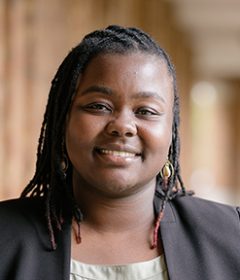
UW ECE Assistant Professor June Lukuyu is part of a multi-organization team that has received a grant to develop machine learning datasets, which will enable fast, flexible, and accessible power systems planning in underserved communities.
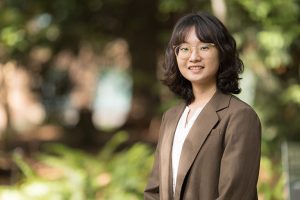 UW ECE Assistant Professor Yiyue Luo is known for her work in intelligent, or “smart,” textiles. At UW ECE, she and her students are expanding this relatively new line of research into developing other forms of intelligent wearable technology.[/caption]
UW ECE Assistant Professor Yiyue Luo found her professional focus in a surprising way: by choosing to avoid things she didn’t like.
Today, Luo leads the Wearable Intelligence Lab at the UW, where she develops intelligent wearable technologies that can monitor health, improve rehabilitation, and provide robots with a more human-like sense of touch.
“It’s easy for me to realize what I don’t like,” Luo said. “I try not to do what I don’t like, and then that choice tends to move me toward something that is a much better fit.”
This approach to life is reflected in how she first became involved in electrical and computer engineering.
Luo said she was interested in science and engineering from a young age, but in high school, she wasn’t sure which field she wanted to pursue. Her father, a materials scientist, encouraged her to follow in his footsteps.
Taking her father’s advice, Luo enrolled in materials science and engineering at the University of Illinois Urbana-Champaign. As she progressed through the program, however, she discovered that her interests were shifting. Undergraduate research experiences exposed her to electronics design, and she became increasingly drawn toward electrical engineering.
UW ECE Assistant Professor Yiyue Luo is known for her work in intelligent, or “smart,” textiles. At UW ECE, she and her students are expanding this relatively new line of research into developing other forms of intelligent wearable technology.[/caption]
UW ECE Assistant Professor Yiyue Luo found her professional focus in a surprising way: by choosing to avoid things she didn’t like.
Today, Luo leads the Wearable Intelligence Lab at the UW, where she develops intelligent wearable technologies that can monitor health, improve rehabilitation, and provide robots with a more human-like sense of touch.
“It’s easy for me to realize what I don’t like,” Luo said. “I try not to do what I don’t like, and then that choice tends to move me toward something that is a much better fit.”
This approach to life is reflected in how she first became involved in electrical and computer engineering.
Luo said she was interested in science and engineering from a young age, but in high school, she wasn’t sure which field she wanted to pursue. Her father, a materials scientist, encouraged her to follow in his footsteps.
Taking her father’s advice, Luo enrolled in materials science and engineering at the University of Illinois Urbana-Champaign. As she progressed through the program, however, she discovered that her interests were shifting. Undergraduate research experiences exposed her to electronics design, and she became increasingly drawn toward electrical engineering.
“The sense of touch is a physically grounded modality that humans take for granted. Information from tactile sensing is extremely valuable for many applications, but collecting it remains challenging because the necessary hardware often does not exist. In my lab, we are creating this needed hardware in new form factors that can capture tactile information in a scalable, comprehensive, and continuous way.” — UW ECE Assistant Professor Yiyue Luo
She had already begun participating in materials science research as an undergraduate, but during her sophomore year she decided to change direction and join the Rogers Research Group. This research group was led by Professor John A. Rogers (now at Northwestern University), who was well-known for his interdisciplinary work in materials science, electronics, and bioengineering.
[caption id="attachment_42080" align="alignright" width="475"]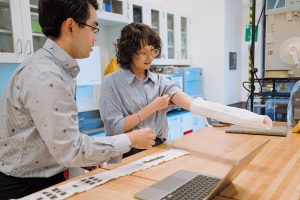 UW ECE postdoctoral scholar and Entrepreneurial Fellow Sen Zhang (left) with Luo in the Wearable Intelligence Lab. Luo is trying on a MultiSensKnit prototype, a sensor-packed knitted sleeve she developed with Zhang that is designed for rehabilitation assessment.[/caption]
At the time, Rogers was exploring epidermal electronics, ultra-thin, flexible electronic devices that stick to human skin like a temporary tattoo. These devices can monitor physiological signals, serve as highly sensitive electronic interfaces, and even deliver targeted therapies. Luo said she found the research fascinating, and it helped to lay a foundation for her later work.
The experience convinced Luo that the future she wanted to pursue was at the intersection of electronics, computing, and human-centered applications.
After receiving her bachelor’s degree in materials science and engineering, Luo decided to pursue a doctoral degree in electrical engineering and computer science. The transition was unconventional because her undergraduate training was in materials science rather than electrical engineering. But for Luo, the decision felt like a natural progression toward the work that excited her most.
She was accepted into MIT’s EECS program, where she was advised by professors Wojciech Matusik and Tomás Palacios.
It was in Matusik’s Computational Design & Fabrication Group where Luo found her true calling. There, she was introduced to a digital knitting machine that transforms digital designs into knitted fabrics. Matusik and his students used the machine to knit conductive yarn into garments, creating a type of wearable technology known as “intelligent textiles” — fabrics embedded with sensors, actuators, and conductive fibers.
[caption id="attachment_42083" align="alignleft" width="475"]
UW ECE postdoctoral scholar and Entrepreneurial Fellow Sen Zhang (left) with Luo in the Wearable Intelligence Lab. Luo is trying on a MultiSensKnit prototype, a sensor-packed knitted sleeve she developed with Zhang that is designed for rehabilitation assessment.[/caption]
At the time, Rogers was exploring epidermal electronics, ultra-thin, flexible electronic devices that stick to human skin like a temporary tattoo. These devices can monitor physiological signals, serve as highly sensitive electronic interfaces, and even deliver targeted therapies. Luo said she found the research fascinating, and it helped to lay a foundation for her later work.
The experience convinced Luo that the future she wanted to pursue was at the intersection of electronics, computing, and human-centered applications.
After receiving her bachelor’s degree in materials science and engineering, Luo decided to pursue a doctoral degree in electrical engineering and computer science. The transition was unconventional because her undergraduate training was in materials science rather than electrical engineering. But for Luo, the decision felt like a natural progression toward the work that excited her most.
She was accepted into MIT’s EECS program, where she was advised by professors Wojciech Matusik and Tomás Palacios.
It was in Matusik’s Computational Design & Fabrication Group where Luo found her true calling. There, she was introduced to a digital knitting machine that transforms digital designs into knitted fabrics. Matusik and his students used the machine to knit conductive yarn into garments, creating a type of wearable technology known as “intelligent textiles” — fabrics embedded with sensors, actuators, and conductive fibers.
[caption id="attachment_42083" align="alignleft" width="475"]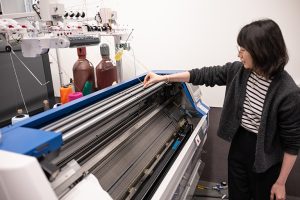 Luo adjusting the digital knitting machine in the Wearable Intelligence Lab. This device transforms digital designs into professional-quality, knitted fabrics.[/caption]
Intelligent textiles, also known as “smart textiles,” can sense, store, process, and communicate information seamlessly and unobtrusively. They have a wide range of potential applications, including monitoring physiological signals and acting as control interfaces for electronic devices.
As she began working with these textile-based sensing systems, Luo realized that fabric offered a uniquely powerful form factor because of its ubiquity. People wear clothing every day and constantly encounter fabrics through furniture, carpets, and bedding. She also recognized the potential these technologies had to capture tactile information that cameras, microphones, and conventional electronics cannot easily detect.
“With smart textiles, we can sense, monitor, and embed important, physically grounded information, well beyond what images, audio, and text can provide,” Luo said. “This information can be fundamental for understanding human behavior and activity, so I think a lot of opportunities emerge from that.”
While at MIT, Luo produced cutting-edge wearable textile technologies, including digitally embroidered smart gloves that can record, reproduce, and transfer tactile interactions. These gloves can help users learn complex physical hand movements and can enable touch-sensitive robot teleoperation. She also created AI-powered sensing textiles — including vests, socks, and gloves — that can record and monitor a person’s physical interactions with their environment in real time. The technology has a wide range of potential applications in healthcare and robotics. KnitUI, another system she developed, is a machine-knitted user interface that allows users to operate devices through pressure-sensitive fabric.
Luo adjusting the digital knitting machine in the Wearable Intelligence Lab. This device transforms digital designs into professional-quality, knitted fabrics.[/caption]
Intelligent textiles, also known as “smart textiles,” can sense, store, process, and communicate information seamlessly and unobtrusively. They have a wide range of potential applications, including monitoring physiological signals and acting as control interfaces for electronic devices.
As she began working with these textile-based sensing systems, Luo realized that fabric offered a uniquely powerful form factor because of its ubiquity. People wear clothing every day and constantly encounter fabrics through furniture, carpets, and bedding. She also recognized the potential these technologies had to capture tactile information that cameras, microphones, and conventional electronics cannot easily detect.
“With smart textiles, we can sense, monitor, and embed important, physically grounded information, well beyond what images, audio, and text can provide,” Luo said. “This information can be fundamental for understanding human behavior and activity, so I think a lot of opportunities emerge from that.”
While at MIT, Luo produced cutting-edge wearable textile technologies, including digitally embroidered smart gloves that can record, reproduce, and transfer tactile interactions. These gloves can help users learn complex physical hand movements and can enable touch-sensitive robot teleoperation. She also created AI-powered sensing textiles — including vests, socks, and gloves — that can record and monitor a person’s physical interactions with their environment in real time. The technology has a wide range of potential applications in healthcare and robotics. KnitUI, another system she developed, is a machine-knitted user interface that allows users to operate devices through pressure-sensitive fabric.
“I believe students need to experience things hands-on. That’s how I learned, especially as an undergraduate. I feel like I didn’t truly understand research until I actually touched the textile samples and gained a tangible understanding of how things worked. I think this is an important part of my research and my teaching philosophy.” — UW ECE Assistant Professor Yiyue Luo
Luo’s research has been published in leading interdisciplinary journals, such as Nature Electronics, and at top human-computer interaction and robotics conferences. Her work has also been featured in major media outlets and exhibitions.
Her contributions have earned numerous honors, including Best Paper at the 2025 ACM Conference on Human Factors in Computing Systems (CHI) and Best Paper Honorable Mentions at the 2025 ACM Symposium on User Interface Software and Technology (UIST) and CHI 2021. Additional recognitions include the 2025 Sony Faculty Innovation Award, the MIT EECS Jin Au Kong PhD Thesis Award, and selection to Forbes’ 2024 30 under 30 North America list in Science.
By the time she completed her doctorate, Luo had established herself as a rising researcher in wearable intelligence and smart textiles. The next step was building a research program of her own.
After receiving her doctoral degree from MIT, Luo joined UW ECE in September 2024 as an assistant professor.
“UW ECE is special in that it’s technical and rigorous, but it’s also open-minded,” Luo said. “It has faculty with deep fundamental knowledge about electronics, and it provides a supportive, interdisciplinary environment. This all allows me to collaborate on impactful projects that have potential for major contributions to science and technology.”
The Wearable Intelligence Lab
[caption id="attachment_42089" align="alignright" width="475"]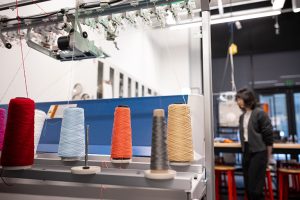 Luo and her students use the digital knitting machine in her lab to knit together traditional yarns (colorful spools) with conductive yarn (gray spool in the foreground), creating fabric that is the basis for different types of intelligent wearable technology.[/caption]
At the UW, Luo established the Wearable Intelligence Lab to advance the integration of wearable technology and artificial intelligence into end-to-end systems for healthcare, robotics, and human-computer interaction.
Under Luo’s guidance, students in the lab are developing new approaches to tactile sensing and wearable intelligence. UW ECE doctoral student Devin Murphy has developed a smart glove with a sense of touch that could support rehabilitation medicine and help teach robots tactile sensing capabilities. UW ECE doctoral student Hongyu Mao and postdoctoral Entrepreneurial Fellow Sen Zhang are working with Luo to develop MultiSensKnit, a sensor-packed knitted sleeve designed for rehabilitation assessment. Another UW ECE doctoral student, Chankyu (Charlie) Han, has developed MagBall, a magnetic-ball sensor capable of capturing subtle interactions across glass, metal, and human skin. Other lab projects include a glove that teaches the user CPR, machine-knitted magnetoactive textiles that provide sensing and haptic feedback for various applications, and sensorimotor stickies, small patches that can deliver localized, on-body sensing and haptic cues in real time.
“The sense of touch is a physically grounded modality that humans take for granted. Information from tactile sensing is extremely valuable for many applications, but collecting it remains challenging because the necessary hardware often does not exist,” Luo said. “In my lab, we are creating this needed hardware in new form factors that can capture tactile information in a scalable, comprehensive, and continuous way.”
[caption id="attachment_42091" align="alignleft" width="475"]
Luo and her students use the digital knitting machine in her lab to knit together traditional yarns (colorful spools) with conductive yarn (gray spool in the foreground), creating fabric that is the basis for different types of intelligent wearable technology.[/caption]
At the UW, Luo established the Wearable Intelligence Lab to advance the integration of wearable technology and artificial intelligence into end-to-end systems for healthcare, robotics, and human-computer interaction.
Under Luo’s guidance, students in the lab are developing new approaches to tactile sensing and wearable intelligence. UW ECE doctoral student Devin Murphy has developed a smart glove with a sense of touch that could support rehabilitation medicine and help teach robots tactile sensing capabilities. UW ECE doctoral student Hongyu Mao and postdoctoral Entrepreneurial Fellow Sen Zhang are working with Luo to develop MultiSensKnit, a sensor-packed knitted sleeve designed for rehabilitation assessment. Another UW ECE doctoral student, Chankyu (Charlie) Han, has developed MagBall, a magnetic-ball sensor capable of capturing subtle interactions across glass, metal, and human skin. Other lab projects include a glove that teaches the user CPR, machine-knitted magnetoactive textiles that provide sensing and haptic feedback for various applications, and sensorimotor stickies, small patches that can deliver localized, on-body sensing and haptic cues in real time.
“The sense of touch is a physically grounded modality that humans take for granted. Information from tactile sensing is extremely valuable for many applications, but collecting it remains challenging because the necessary hardware often does not exist,” Luo said. “In my lab, we are creating this needed hardware in new form factors that can capture tactile information in a scalable, comprehensive, and continuous way.”
[caption id="attachment_42091" align="alignleft" width="475"]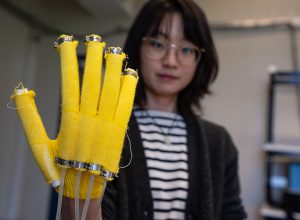 Luo demonstrates a digitally machine-knitted assistive glove, designed to support hand movement.[/caption]
Luo’s research is interdisciplinary by nature.
At the UW, she collaborates with faculty and students across multiple disciplines to explore new applications for wearable technology and tactile sensing. She is working with UW ECE Professor Chet Moritz, who holds joint appointments in UW Medicine, on rehabilitation technologies, including the MultiSensKnit sleeve she is developing with Zhang. She has also collaborated with UW ECE Associate Professor Sam Burden on equipping robots with human-like sensing capabilities for manipulation tasks and with Siddhartha (Sidd) Srinivasa, a professor in the Paul G. Allen School of Computer Science & Engineering, on human-computer interaction. Beyond engineering and computer science, Luo and UW ECE doctoral student Devin Murphy are brainstorming new tactile-sensing applications with UW Assistant Professor Meichun Liu and her industrial design students. Luo also provides digital knitting machine workshops in the Allen School’s Fabrication Research Lab, helping to introduce students from a variety of disciplines to wearable computing and textile-based technologies.
As an educator, Luo instructs and mentors a mix of undergraduate and graduate students. She said she enjoys teaching and learning from her students as well as watching them develop confidence in their independent thinking. To help facilitate that growth, she encourages students to remain open-minded and pursue experiential learning alongside their academic coursework.
“I believe students need to experience things hands-on,” Luo said. “That’s how I learned, especially as an undergraduate. I feel like I didn’t truly understand research until I actually touched the textile samples and gained a tangible understanding of how things worked. I think this is an important part of my research and my teaching philosophy.”
For more information about UW ECE Assistant Professor Yiyue Luo, visit her bio page and the Wearable Intelligence Lab website.
[post_title] => Yiyue Luo — developing intelligent wearable technology for healthcare, robotics and human-computer interaction
[post_excerpt] =>
[post_status] => publish
[comment_status] => closed
[ping_status] => closed
[post_password] =>
[post_name] => yiyue-luo-developing-intelligent-wearable-technology-for-healthcare-robotics-and-human-computer-interaction
[to_ping] =>
[pinged] =>
[post_modified] => 2026-09-21 11:52:22
[post_modified_gmt] => 2026-09-21 18:52:22
[post_content_filtered] =>
[post_parent] => 0
[guid] => https://www.ece.uw.edu/?post_type=spotlight&p=42074
[menu_order] => 1
[post_type] => spotlight
[post_mime_type] =>
[comment_count] => 0
[filter] => raw
)
[1] => WP_Post Object
(
[ID] => 41947
[post_author] => 27
[post_date] => 2026-08-28 15:41:10
[post_date_gmt] => 2026-08-28 22:41:10
[post_content] => Adapted from an article by Kristin Osborne / Paul G. Allen School of Computer Science & Engineering
[caption id="attachment_41949" align="alignright" width="525"]
Luo demonstrates a digitally machine-knitted assistive glove, designed to support hand movement.[/caption]
Luo’s research is interdisciplinary by nature.
At the UW, she collaborates with faculty and students across multiple disciplines to explore new applications for wearable technology and tactile sensing. She is working with UW ECE Professor Chet Moritz, who holds joint appointments in UW Medicine, on rehabilitation technologies, including the MultiSensKnit sleeve she is developing with Zhang. She has also collaborated with UW ECE Associate Professor Sam Burden on equipping robots with human-like sensing capabilities for manipulation tasks and with Siddhartha (Sidd) Srinivasa, a professor in the Paul G. Allen School of Computer Science & Engineering, on human-computer interaction. Beyond engineering and computer science, Luo and UW ECE doctoral student Devin Murphy are brainstorming new tactile-sensing applications with UW Assistant Professor Meichun Liu and her industrial design students. Luo also provides digital knitting machine workshops in the Allen School’s Fabrication Research Lab, helping to introduce students from a variety of disciplines to wearable computing and textile-based technologies.
As an educator, Luo instructs and mentors a mix of undergraduate and graduate students. She said she enjoys teaching and learning from her students as well as watching them develop confidence in their independent thinking. To help facilitate that growth, she encourages students to remain open-minded and pursue experiential learning alongside their academic coursework.
“I believe students need to experience things hands-on,” Luo said. “That’s how I learned, especially as an undergraduate. I feel like I didn’t truly understand research until I actually touched the textile samples and gained a tangible understanding of how things worked. I think this is an important part of my research and my teaching philosophy.”
For more information about UW ECE Assistant Professor Yiyue Luo, visit her bio page and the Wearable Intelligence Lab website.
[post_title] => Yiyue Luo — developing intelligent wearable technology for healthcare, robotics and human-computer interaction
[post_excerpt] =>
[post_status] => publish
[comment_status] => closed
[ping_status] => closed
[post_password] =>
[post_name] => yiyue-luo-developing-intelligent-wearable-technology-for-healthcare-robotics-and-human-computer-interaction
[to_ping] =>
[pinged] =>
[post_modified] => 2026-09-21 11:52:22
[post_modified_gmt] => 2026-09-21 18:52:22
[post_content_filtered] =>
[post_parent] => 0
[guid] => https://www.ece.uw.edu/?post_type=spotlight&p=42074
[menu_order] => 1
[post_type] => spotlight
[post_mime_type] =>
[comment_count] => 0
[filter] => raw
)
[1] => WP_Post Object
(
[ID] => 41947
[post_author] => 27
[post_date] => 2026-08-28 15:41:10
[post_date_gmt] => 2026-08-28 22:41:10
[post_content] => Adapted from an article by Kristin Osborne / Paul G. Allen School of Computer Science & Engineering
[caption id="attachment_41949" align="alignright" width="525"]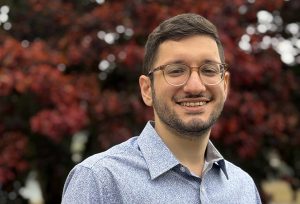 UW ECE doctoral student Malek Itani has received a 2026 Marconi Society Paul Baran Young Scholar Award for exceptional early-career research that is advancing the future of information and communication technology.[/caption]
In 2022, UW ECE doctoral student Malek Itani purchased his first pair of Apple Airpods Pro in a pre-holiday sale. When he put them in his ears, something clicked — and it wasn’t a sound, but rather an idea.
“I put them on my ears, and I turned on noise canceling, and suddenly I felt like I was in my own personal space,” said Itani, a research assistant in the Mobile Intelligence Lab led by Allen School professor Shyam Gollakota. “I thought, ‘Wow, we can do something here.’
“But the model I was working on at the time was kind of huge, and not real-time, and definitely not something you can put on earbuds,” he continued. “And Shyam said, ‘But what if you can?’ “
Itani embraced the challenge. And after four years of steady and, at times, astounding progress, he received a Marconi Society Paul Baran Young Scholar Award for exceptional early-career research that is advancing the future of information and communications technology (ICT). Itani is one of only three scholars selected from a record-high number of nominees from around the world; he and his fellow honorees will be formally recognized at the Marconi Awards Gala & Institute Forums November 4-6 in San Francisco, California.
“Malek has been a key part of every major contribution to the field of superhuman hearing in recent years,” said Gollakota. “He entered his Ph.D. with a background in RF and backscatter, but he rapidly mastered audio signal processing and deep learning, which is very impressive.”
As an undergraduate, Itani was eager to explore different areas of his chosen field. He dabbled in the aforementioned radiofrequency (RF) communication, embedded systems, robotics and even competitive programming — all the while resisting well-meaning suggestions that he specialize. That breadth of experience was an asset in Gollakota’s lab, where the research is cross-disciplinary and the members approach problems from different, sometimes unexpected, angles.
Itani embodied this ethos during his first foray into the soundscape, which focused not on in-ear capabilities but around-the-room. In his first paper as a primary author, Itani and co-primary author Tuochao Chen, a Ph.D. student in the Allen School, introduced acoustic swarms, a system that creates speech zones in a room by tracking and separating multiple speakers simultaneously. The system consists of a neural network paired with a set of small robotic microphones that self-distribute across a space using only sound — no cameras or special substrate required. The robots automatically return to their charging station after deployment, making the system portable and easy to set up in new locations.
As it turned out, the project was Itani’s ideal introduction to his new line of research.
“The transition from RF to audio is actually simple, because you work with waves and frequencies — but instead of looking at gigahertz, you’re now looking at kilohertz,” Itani explained, “In some sense, it’s easier working with sound, because there’s less data to process. And it’s also more fun to work with, because you get to hear the end product.”
It was when he teamed up with another labmate, Bandhav Veluri (Ph.D., ‘25), on a project called Waveformer that he began to embrace this new direction.
“I had a lot of background in embedded systems because of my undergraduate work and because of the robots,” Itani said. “I was able to take that and port it over to an embedded system, run it in real time, and integrate it with the noise-cancelling headsets. That’s where I started to really learn about real-time audio processing.”
UW ECE doctoral student Malek Itani has received a 2026 Marconi Society Paul Baran Young Scholar Award for exceptional early-career research that is advancing the future of information and communication technology.[/caption]
In 2022, UW ECE doctoral student Malek Itani purchased his first pair of Apple Airpods Pro in a pre-holiday sale. When he put them in his ears, something clicked — and it wasn’t a sound, but rather an idea.
“I put them on my ears, and I turned on noise canceling, and suddenly I felt like I was in my own personal space,” said Itani, a research assistant in the Mobile Intelligence Lab led by Allen School professor Shyam Gollakota. “I thought, ‘Wow, we can do something here.’
“But the model I was working on at the time was kind of huge, and not real-time, and definitely not something you can put on earbuds,” he continued. “And Shyam said, ‘But what if you can?’ “
Itani embraced the challenge. And after four years of steady and, at times, astounding progress, he received a Marconi Society Paul Baran Young Scholar Award for exceptional early-career research that is advancing the future of information and communications technology (ICT). Itani is one of only three scholars selected from a record-high number of nominees from around the world; he and his fellow honorees will be formally recognized at the Marconi Awards Gala & Institute Forums November 4-6 in San Francisco, California.
“Malek has been a key part of every major contribution to the field of superhuman hearing in recent years,” said Gollakota. “He entered his Ph.D. with a background in RF and backscatter, but he rapidly mastered audio signal processing and deep learning, which is very impressive.”
As an undergraduate, Itani was eager to explore different areas of his chosen field. He dabbled in the aforementioned radiofrequency (RF) communication, embedded systems, robotics and even competitive programming — all the while resisting well-meaning suggestions that he specialize. That breadth of experience was an asset in Gollakota’s lab, where the research is cross-disciplinary and the members approach problems from different, sometimes unexpected, angles.
Itani embodied this ethos during his first foray into the soundscape, which focused not on in-ear capabilities but around-the-room. In his first paper as a primary author, Itani and co-primary author Tuochao Chen, a Ph.D. student in the Allen School, introduced acoustic swarms, a system that creates speech zones in a room by tracking and separating multiple speakers simultaneously. The system consists of a neural network paired with a set of small robotic microphones that self-distribute across a space using only sound — no cameras or special substrate required. The robots automatically return to their charging station after deployment, making the system portable and easy to set up in new locations.
As it turned out, the project was Itani’s ideal introduction to his new line of research.
“The transition from RF to audio is actually simple, because you work with waves and frequencies — but instead of looking at gigahertz, you’re now looking at kilohertz,” Itani explained, “In some sense, it’s easier working with sound, because there’s less data to process. And it’s also more fun to work with, because you get to hear the end product.”
It was when he teamed up with another labmate, Bandhav Veluri (Ph.D., ‘25), on a project called Waveformer that he began to embrace this new direction.
“I had a lot of background in embedded systems because of my undergraduate work and because of the robots,” Itani said. “I was able to take that and port it over to an embedded system, run it in real time, and integrate it with the noise-cancelling headsets. That’s where I started to really learn about real-time audio processing.”
"I feel like I’ve hit a niche that’s going to be so transformational, and it’s going to be in billions of devices. It’s going to change the way we hear the world." — UW ECE doctoral student Malek Itani, 2026 Paul Baran Young Scholar
The result was the first neural network capable of real-time, streaming target sound extraction, which the researchers then translated into semantic hearing. Using off-the-shelf headphones paired with a smartphone, Itani and Veluri created a system that enabled the wearer to tailor what sounds they hear in their environment. For example, a person could program the device so that they could hear bird song while walking in the park but not the sound of nearby traffic. A subsequent project, target speech hearing, enabled wearers to focus on the voice of a single companion in a crowd simply by looking at them. The system leverages AI to learn and latch onto the target person’s speech patterns, which it plays back to the wearer in real time while canceling out other voices.
Itani and Chen then extended the wearer’s control over their soundscape from selected sounds to a selected space with a prototype headset that enabled the wearer to create a sound bubble. All sounds within the bubble’s perimeter are heard clearly; sounds outside the bubble are muffled or silenced. An onboard neural network determines which sounds to amplify or suppress based on the distance of each source from the embedded microphones.
That successful proof of concept inspired Itani to aim smaller and refine the technology for earbuds and hearing aids.
“Hearing aids are a natural use case,” Itani said. “In a noisy environment, hearing aids will amplify everything, but if you use AI you can amplify specific sounds that people care about. And you can recover not only what they would have heard, but you can also recover things that humans normally can’t hear. That’s where the concept of superhuman hearing comes from — you’re extending what’s possible with normal hearing.”
But this use case required the team to incorporate AI into devices with significant power and processing constraints. Last year, Itani, Chen and Gollakota partially answered that question with the development of TF-MLPNet, the first real-time neural speech separation network capable of running on low-power hearables like earbuds and hearing aids. They achieved another first with the introduction of NeuralAids, a programmable on-device AI platform for wireless hearables that achieves real-time speech enhancement under strict power constraints.
It wasn’t long before the team’s progress attracted the attention of industry. The team co-founded a UW startup, Hearvana AI, which raised $6 million last fall to support their push to bring acoustic intelligence to market.
As for what happens next, Itani says to stay tuned.
“I feel like I’ve hit a niche that’s going to be so transformational, and it’s going to be in billions of devices. It’s going to change the way we hear the world,” Itani said. ”Because of how important this is going to be, and how much this is going to change people’s lives, it genuinely feels like I have this responsibility to push this forward. I get to impact many, many people with this.”
To learn more, read the Marconi Society announcement and Itani’s Young Scholar profile, and visit Itani’s personal website.
[post_title] => UW ECE student Malek Itani earns Marconi Society Young Scholar Award for advancing ‘superhuman’ hearing with AI
[post_excerpt] =>
[post_status] => publish
[comment_status] => closed
[ping_status] => closed
[post_password] =>
[post_name] => malek-itani-2026-marconi-award
[to_ping] =>
[pinged] =>
[post_modified] => 2026-08-28 15:41:44
[post_modified_gmt] => 2026-08-28 22:41:44
[post_content_filtered] =>
[post_parent] => 0
[guid] => https://www.ece.uw.edu/?post_type=spotlight&p=41947
[menu_order] => 2
[post_type] => spotlight
[post_mime_type] =>
[comment_count] => 0
[filter] => raw
)
[2] => WP_Post Object
(
[ID] => 41756
[post_author] => 27
[post_date] => 2026-08-05 10:26:53
[post_date_gmt] => 2026-08-05 17:26:53
[post_content] => By Wayne Gillam / UW ECE News
[caption id="attachment_41758" align="alignright" width="580"]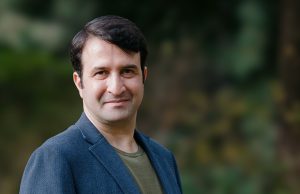 UW ECE Assistant Professor Hossein Naghavi is leading one of 278 research projects chosen for the U.S. Department of Energy’s Genesis Mission from more than 5,000 applicants nationwide. His project is focused on developing an artificially intelligent augmented reality headset that would enable the user to see through smoke, fog, debris, and other nonconductive materials. Photo by Ryan Hoover / UW ECE[/caption]
UW ECE Assistant Professor Hossein Naghavi is leading a multi-institutional research project selected for the U.S. Department of Energy’s Genesis Mission, a historic national initiative aimed at building the world’s most powerful integrated science discovery platform. His project is one of only 278 selected nationwide from more than 5,000 applicants, the largest response to a funding opportunity in DOE history. The selected projects were announced on July 22 at the Genesis Mission Summit in Washington, D.C.
Naghavi’s project, “Neuromorphic Terahertz Imaging via Analog Compute-in-Memory in AI-Driven Augmented Reality Hardware,” is focused on developing a low-power, high-bandwidth augmented reality headset that combines terahertz imaging with intelligent sensing and computing. Terahertz waves sit on the electromagnetic spectrum between microwave and optical frequencies. They can be used to see through many nonconductive materials and identify substances based on unique wave absorption and reflection signatures. The headset would enable the user to see through smoke, fog, debris, and other nonconductive matter. Potential applications include firefighting, emergency response, autonomous navigation, security screening, industrial inspection, biomedical sensing, and beyond 5G communication networks.
“I am honored to represent the University of Washington as part of the DOE’s Genesis Mission,” Naghavi said. “This is an exciting project that is rethinking how intelligent sensors are built, and by doing so, the research is supporting national priorities in energy-efficient computing and next-generation hardware.”
According to the DOE, the Genesis Mission was designed to address some of the nation’s most pressing energy, scientific, and engineering challenges while doubling America’s scientific productivity. By uniting government, industry, academia, and philanthropy, the initiative accelerates breakthroughs in energy, scientific discovery, and national security through a new platform combining AI, supercomputing, quantum systems, and advanced scientific instruments.
[caption id="attachment_41763" align="alignleft" width="430"]
UW ECE Assistant Professor Hossein Naghavi is leading one of 278 research projects chosen for the U.S. Department of Energy’s Genesis Mission from more than 5,000 applicants nationwide. His project is focused on developing an artificially intelligent augmented reality headset that would enable the user to see through smoke, fog, debris, and other nonconductive materials. Photo by Ryan Hoover / UW ECE[/caption]
UW ECE Assistant Professor Hossein Naghavi is leading a multi-institutional research project selected for the U.S. Department of Energy’s Genesis Mission, a historic national initiative aimed at building the world’s most powerful integrated science discovery platform. His project is one of only 278 selected nationwide from more than 5,000 applicants, the largest response to a funding opportunity in DOE history. The selected projects were announced on July 22 at the Genesis Mission Summit in Washington, D.C.
Naghavi’s project, “Neuromorphic Terahertz Imaging via Analog Compute-in-Memory in AI-Driven Augmented Reality Hardware,” is focused on developing a low-power, high-bandwidth augmented reality headset that combines terahertz imaging with intelligent sensing and computing. Terahertz waves sit on the electromagnetic spectrum between microwave and optical frequencies. They can be used to see through many nonconductive materials and identify substances based on unique wave absorption and reflection signatures. The headset would enable the user to see through smoke, fog, debris, and other nonconductive matter. Potential applications include firefighting, emergency response, autonomous navigation, security screening, industrial inspection, biomedical sensing, and beyond 5G communication networks.
“I am honored to represent the University of Washington as part of the DOE’s Genesis Mission,” Naghavi said. “This is an exciting project that is rethinking how intelligent sensors are built, and by doing so, the research is supporting national priorities in energy-efficient computing and next-generation hardware.”
According to the DOE, the Genesis Mission was designed to address some of the nation’s most pressing energy, scientific, and engineering challenges while doubling America’s scientific productivity. By uniting government, industry, academia, and philanthropy, the initiative accelerates breakthroughs in energy, scientific discovery, and national security through a new platform combining AI, supercomputing, quantum systems, and advanced scientific instruments.
[caption id="attachment_41763" align="alignleft" width="430"] The U.S. Department of Energy’s Genesis Mission is a historic national initiative aimed at building the world’s most powerful integrated science discovery platform.[/caption]
Projects under the Genesis Mission are collaborative by design; teams must draw on the expertise of researchers from academia, industry, and/or national laboratories. Naghavi’s co-investigators include Milad Koohi, an assistant professor of electrical and computer engineering at Texas A&M University, Morteza Fayazi, an assistant professor of electrical and computer engineering at the University of Utah, and Daniel Elmhurst, chief executive officer of ChipNexus (formerly PrimisAI). The group is also collaborating with John Josephakis, global vice president of high-performance computing and supercomputing at Nvidia.
Naghavi and his team have been selected by the DOE under the Genesis Mission for Phase I funding. During this nine-month phase, the team will design and demonstrate a research workflow that integrates AI with scientific investigation. The DOE will evaluate whether the approach can accelerate discovery, improve predictive capabilities, enhance experimentation, and generate new scientific insights. Projects demonstrating strong potential for transformative scientific capabilities may be considered for additional Genesis Mission funding.
Naghavi said that the nine-month timeframe was ambitious, but he and his colleagues were up to the challenge.
“This project brings together expertise in terahertz systems, semiconductor devices, integrated microsystems, AI methods/hardware, and high-performance computing,” Naghavi said. “By combining those strengths, we can move much faster toward a practical solution than any one institution could alone.”
Read this DOE press release to learn more about the first Genesis Mission projects selected to accelerate AI-driven scientific discovery.
[post_title] => UW ECE-led project selected for Department of Energy’s Genesis Mission
[post_excerpt] =>
[post_status] => publish
[comment_status] => closed
[ping_status] => closed
[post_password] =>
[post_name] => uw-ece-hossein-naghavi-genesis-mission
[to_ping] =>
[pinged] =>
[post_modified] => 2026-08-05 10:27:46
[post_modified_gmt] => 2026-08-05 17:27:46
[post_content_filtered] =>
[post_parent] => 0
[guid] => https://www.ece.uw.edu/?post_type=spotlight&p=41756
[menu_order] => 3
[post_type] => spotlight
[post_mime_type] =>
[comment_count] => 0
[filter] => raw
)
[3] => WP_Post Object
(
[ID] => 41742
[post_author] => 27
[post_date] => 2026-09-14 16:15:57
[post_date_gmt] => 2026-09-14 23:15:57
[post_content] =>
[post_title] => UW ECE introduces virtual reality training for students to help fill crucial semiconductor jobs
[post_excerpt] =>
[post_status] => publish
[comment_status] => closed
[ping_status] => closed
[post_password] =>
[post_name] => uw-ece-virtual-reality-training
[to_ping] =>
[pinged] =>
[post_modified] => 2026-09-15 08:30:00
[post_modified_gmt] => 2026-09-15 15:30:00
[post_content_filtered] =>
[post_parent] => 0
[guid] => https://www.ece.uw.edu/?post_type=spotlight&p=41742
[menu_order] => 4
[post_type] => spotlight
[post_mime_type] =>
[comment_count] => 0
[filter] => raw
)
[4] => WP_Post Object
(
[ID] => 41485
[post_author] => 27
[post_date] => 2026-07-07 14:39:35
[post_date_gmt] => 2026-07-07 21:39:35
[post_content] =>
[post_title] => Elevating emerging engineers
[post_excerpt] =>
[post_status] => publish
[comment_status] => closed
[ping_status] => closed
[post_password] =>
[post_name] => elevating-emerging-engineers
[to_ping] =>
[pinged] =>
[post_modified] => 2026-07-07 14:40:58
[post_modified_gmt] => 2026-07-07 21:40:58
[post_content_filtered] =>
[post_parent] => 0
[guid] => https://www.ece.uw.edu/?post_type=spotlight&p=41485
[menu_order] => 5
[post_type] => spotlight
[post_mime_type] =>
[comment_count] => 0
[filter] => raw
)
[5] => WP_Post Object
(
[ID] => 41395
[post_author] => 27
[post_date] => 2026-06-22 09:39:45
[post_date_gmt] => 2026-06-22 16:39:45
[post_content] => By Wayne Gillam / UW ECE News
[caption id="attachment_41398" align="alignright" width="600"]
The U.S. Department of Energy’s Genesis Mission is a historic national initiative aimed at building the world’s most powerful integrated science discovery platform.[/caption]
Projects under the Genesis Mission are collaborative by design; teams must draw on the expertise of researchers from academia, industry, and/or national laboratories. Naghavi’s co-investigators include Milad Koohi, an assistant professor of electrical and computer engineering at Texas A&M University, Morteza Fayazi, an assistant professor of electrical and computer engineering at the University of Utah, and Daniel Elmhurst, chief executive officer of ChipNexus (formerly PrimisAI). The group is also collaborating with John Josephakis, global vice president of high-performance computing and supercomputing at Nvidia.
Naghavi and his team have been selected by the DOE under the Genesis Mission for Phase I funding. During this nine-month phase, the team will design and demonstrate a research workflow that integrates AI with scientific investigation. The DOE will evaluate whether the approach can accelerate discovery, improve predictive capabilities, enhance experimentation, and generate new scientific insights. Projects demonstrating strong potential for transformative scientific capabilities may be considered for additional Genesis Mission funding.
Naghavi said that the nine-month timeframe was ambitious, but he and his colleagues were up to the challenge.
“This project brings together expertise in terahertz systems, semiconductor devices, integrated microsystems, AI methods/hardware, and high-performance computing,” Naghavi said. “By combining those strengths, we can move much faster toward a practical solution than any one institution could alone.”
Read this DOE press release to learn more about the first Genesis Mission projects selected to accelerate AI-driven scientific discovery.
[post_title] => UW ECE-led project selected for Department of Energy’s Genesis Mission
[post_excerpt] =>
[post_status] => publish
[comment_status] => closed
[ping_status] => closed
[post_password] =>
[post_name] => uw-ece-hossein-naghavi-genesis-mission
[to_ping] =>
[pinged] =>
[post_modified] => 2026-08-05 10:27:46
[post_modified_gmt] => 2026-08-05 17:27:46
[post_content_filtered] =>
[post_parent] => 0
[guid] => https://www.ece.uw.edu/?post_type=spotlight&p=41756
[menu_order] => 3
[post_type] => spotlight
[post_mime_type] =>
[comment_count] => 0
[filter] => raw
)
[3] => WP_Post Object
(
[ID] => 41742
[post_author] => 27
[post_date] => 2026-09-14 16:15:57
[post_date_gmt] => 2026-09-14 23:15:57
[post_content] =>
[post_title] => UW ECE introduces virtual reality training for students to help fill crucial semiconductor jobs
[post_excerpt] =>
[post_status] => publish
[comment_status] => closed
[ping_status] => closed
[post_password] =>
[post_name] => uw-ece-virtual-reality-training
[to_ping] =>
[pinged] =>
[post_modified] => 2026-09-15 08:30:00
[post_modified_gmt] => 2026-09-15 15:30:00
[post_content_filtered] =>
[post_parent] => 0
[guid] => https://www.ece.uw.edu/?post_type=spotlight&p=41742
[menu_order] => 4
[post_type] => spotlight
[post_mime_type] =>
[comment_count] => 0
[filter] => raw
)
[4] => WP_Post Object
(
[ID] => 41485
[post_author] => 27
[post_date] => 2026-07-07 14:39:35
[post_date_gmt] => 2026-07-07 21:39:35
[post_content] =>
[post_title] => Elevating emerging engineers
[post_excerpt] =>
[post_status] => publish
[comment_status] => closed
[ping_status] => closed
[post_password] =>
[post_name] => elevating-emerging-engineers
[to_ping] =>
[pinged] =>
[post_modified] => 2026-07-07 14:40:58
[post_modified_gmt] => 2026-07-07 21:40:58
[post_content_filtered] =>
[post_parent] => 0
[guid] => https://www.ece.uw.edu/?post_type=spotlight&p=41485
[menu_order] => 5
[post_type] => spotlight
[post_mime_type] =>
[comment_count] => 0
[filter] => raw
)
[5] => WP_Post Object
(
[ID] => 41395
[post_author] => 27
[post_date] => 2026-06-22 09:39:45
[post_date_gmt] => 2026-06-22 16:39:45
[post_content] => By Wayne Gillam / UW ECE News
[caption id="attachment_41398" align="alignright" width="600"] UW ECE Assistant Professor June Lukuyu is part of a multi-organization team that has received a Climate Change AI Innovation Grant to develop machine learning datasets, which will enable fast, flexible, and accessible power systems planning in underserved communities in the Global South. Photo by Ryan Hoover / UW ECE[/caption]
Access to reliable electricity remains out of reach for millions of people across the Global South. At the same time, the worldwide transition to renewable energy is accelerating. Bridging this gap — ensuring that underserved communities can benefit from clean, reliable power — is one of the most important energy challenges today. To help address this issue, researchers are increasingly turning to artificial intelligence, or AI, to design faster, more accessible solutions.
Renewable energy sources, such as solar, wind, and hydropower, are being adopted at growing rates around the world. This shift offers clear benefits, from reducing greenhouse gas emissions to improving public health. But progress is uneven. Wealthier regions with established infrastructure are advancing quickly, while many lower-resource communities face significant barriers to deploying modern energy systems.
These challenges are especially pronounced in the Global South, which includes many countries across Africa, South America, and Asia. Expanding energy access in these regions often means reaching remote or underserved communities — an effort that requires careful planning, coordination, and innovation. With this in mind, governments, industry leaders, and engineers are forming new partnerships to design power systems that are not only sustainable, but also tailored to the specific needs of local communities.
UW ECE Assistant Professor June Lukuyu is part of a multi-organization team that has received a Climate Change AI Innovation Grant to develop machine learning datasets, which will enable fast, flexible, and accessible power systems planning in underserved communities in the Global South. Photo by Ryan Hoover / UW ECE[/caption]
Access to reliable electricity remains out of reach for millions of people across the Global South. At the same time, the worldwide transition to renewable energy is accelerating. Bridging this gap — ensuring that underserved communities can benefit from clean, reliable power — is one of the most important energy challenges today. To help address this issue, researchers are increasingly turning to artificial intelligence, or AI, to design faster, more accessible solutions.
Renewable energy sources, such as solar, wind, and hydropower, are being adopted at growing rates around the world. This shift offers clear benefits, from reducing greenhouse gas emissions to improving public health. But progress is uneven. Wealthier regions with established infrastructure are advancing quickly, while many lower-resource communities face significant barriers to deploying modern energy systems.
These challenges are especially pronounced in the Global South, which includes many countries across Africa, South America, and Asia. Expanding energy access in these regions often means reaching remote or underserved communities — an effort that requires careful planning, coordination, and innovation. With this in mind, governments, industry leaders, and engineers are forming new partnerships to design power systems that are not only sustainable, but also tailored to the specific needs of local communities.
“We’re trying to make power systems planning more accessible to people who are currently left out of the process. Power systems planning is how countries decide what power infrastructure to build, where, and when. It directly shapes whether or not communities get reliable, affordable, and clean electricity.” — UW ECE Assistant Professor June Lukuyu
UW ECE Assistant Professor June Lukuyu is working at the forefront of this effort. A member of the Clean Energy Institute and leader of the Interdisciplinary Energy Analytics for Society, or IDEAS, research group at the UW, Lukuyu focuses on developing sustainable, inclusive, and integrated energy systems for underserved communities. She is also part of a multi-organization team that recently received a Climate Change AI Innovation Grant — an award that supports the use of AI to address critical climate challenges.
The project funded by the award from Climate Change AI is one of just 12 selected from more than 400 applications representing 78 countries, underscoring both its significance and its global relevance. With this support, Lukuyu and her collaborators are developing machine learning datasets that will enable faster, more flexible, and more accessible power systems planning in lower-resource settings.
Why AI matters for energy planning
At the center of this work is machine learning, a branch of AI that allows computers to learn from data and make predictions. In the context of energy systems, machine learning can help planners quickly evaluate different scenarios — reducing the time and expertise required to design effective power networks.
Traditionally, power systems planning relies on complex optimization models that can take days to produce a single scenario and often require specialized technical knowledge. These constraints limit who can participate in planning processes and slow progress, particularly in regions where resources and expertise are limited.
“This grant is supporting work that sits at the intersection of two things that don’t always come together: cutting-edge machine learning research and the practical realities of energy planning in under-resourced contexts,” Lukuyu said. “A lot of sophisticated power systems modeling work never makes it out of the lab, and a lot of planning work in the Global South is constrained by the tools available. We’re trying to close that gap.”
Building smarter, more accessible tools
[caption id="attachment_41400" align="alignright" width="400"]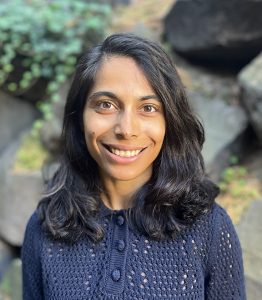 UW ECE doctoral student Ahana Mukherjee will be developing machine learning models that are optimized for power systems planning in the Global South. The models will be trained on the datasets Lukuyu’s team is curating. Photo courtesy of June Lukuyu.[/caption]
Lukuyu is collaborating on the project with Mohini Bariya, Joshua Adkins, and Genevieve Flaspohler from Rhiza Research, a nonprofit focused on identifying and addressing gaps in data, technology, and technical capacity in community-centered projects. The partnership combines expertise in power systems planning, machine learning, and applied research, along with strong connections to practitioners in the field.
Also contributing to the work is UW ECE doctoral student Ahana Mukherjee, who is co-advised by Lukuyu and Bariya. Mukherjee will develop machine learning models trained on the datasets the team is curating — datasets designed to serve as the foundation for faster and more user-friendly planning tools.
This effort builds on earlier work by Lukuyu, her IDEAS research group, and members of Rhiza Research. In a previous project funded by Climate Change AI, the team used machine learning to detect and localize power losses caused by malfunctioning equipment and overloaded distribution lines in Ghana. The goal of their approach was to help operators increase efficiency through precisely targeted interventions to address grid failures.
In the new project, the team is expanding that work by focusing on the datasets themselves — an essential building block for effective AI tools.
“The tools that exist today, both open source and commercial, are built on optimization models that can take days to run to come up with one planning scenario,” Lukuyu explained. “They also require significant technical expertise, which excludes many of the planners, researchers, and policymakers who need them most. We want to build something that’s simpler, faster, and computationally light — but still genuinely useful. And the foundation for that is curating a high-quality dataset.”
UW ECE doctoral student Ahana Mukherjee will be developing machine learning models that are optimized for power systems planning in the Global South. The models will be trained on the datasets Lukuyu’s team is curating. Photo courtesy of June Lukuyu.[/caption]
Lukuyu is collaborating on the project with Mohini Bariya, Joshua Adkins, and Genevieve Flaspohler from Rhiza Research, a nonprofit focused on identifying and addressing gaps in data, technology, and technical capacity in community-centered projects. The partnership combines expertise in power systems planning, machine learning, and applied research, along with strong connections to practitioners in the field.
Also contributing to the work is UW ECE doctoral student Ahana Mukherjee, who is co-advised by Lukuyu and Bariya. Mukherjee will develop machine learning models trained on the datasets the team is curating — datasets designed to serve as the foundation for faster and more user-friendly planning tools.
This effort builds on earlier work by Lukuyu, her IDEAS research group, and members of Rhiza Research. In a previous project funded by Climate Change AI, the team used machine learning to detect and localize power losses caused by malfunctioning equipment and overloaded distribution lines in Ghana. The goal of their approach was to help operators increase efficiency through precisely targeted interventions to address grid failures.
In the new project, the team is expanding that work by focusing on the datasets themselves — an essential building block for effective AI tools.
“The tools that exist today, both open source and commercial, are built on optimization models that can take days to run to come up with one planning scenario,” Lukuyu explained. “They also require significant technical expertise, which excludes many of the planners, researchers, and policymakers who need them most. We want to build something that’s simpler, faster, and computationally light — but still genuinely useful. And the foundation for that is curating a high-quality dataset.”
From research to real-world impact
[caption id="attachment_41404" align="alignright" width="400"]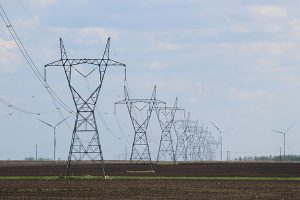 This project builds on earlier work using machine learning to detect and localize power losses from faulty equipment and overloaded power lines in Ghana. The team is now focusing on improving datasets as a foundation for effective AI tools. Photo courtesy of the American Public Power Association.[/caption]
A key goal of the project is to ensure that these tools are not only developed, but also adopted. Lukuyu emphasizes the importance of collaboration among engineers, governments, nonprofits, utility companies, and energy developers — as well as meaningful input from the communities that these power systems are intended to serve.
Looking ahead, she plans to work closely with universities, practitioners, and community partners in the Global South to share knowledge and build capacity. By integrating these tools into academic and professional settings, the team hopes to expand who can participate in power systems planning.
“The transition to renewable energy needs to be a just transition,” Lukuyu said. “That means people need to be able to participate in the decisions that shape their energy systems. Right now, the complexity of planning tools is a barrier to that participation. If we can lower that barrier, we can open the door to a much broader set of voices.”
By making power systems planning more accessible, Lukuyu and her collaborators aim to help communities design energy systems that reflect their needs and priorities — ensuring that the benefits of the clean energy transition are shared more equitably around the world.
More information about UW ECE Assistant Professor June Lukuyu can be found on her UW ECE bio page and the IDEAS research group website.
[post_title] => Using AI to improve power systems planning in the Global South
[post_excerpt] =>
[post_status] => publish
[comment_status] => closed
[ping_status] => closed
[post_password] =>
[post_name] => ai-for-power-systems-planning
[to_ping] =>
[pinged] =>
[post_modified] => 2026-06-22 09:39:45
[post_modified_gmt] => 2026-06-22 16:39:45
[post_content_filtered] =>
[post_parent] => 0
[guid] => https://www.ece.uw.edu/?post_type=spotlight&p=41395
[menu_order] => 6
[post_type] => spotlight
[post_mime_type] =>
[comment_count] => 0
[filter] => raw
)
)
[post_count] => 6
[current_post] => -1
[before_loop] => 1
[in_the_loop] =>
[post] => WP_Post Object
(
[ID] => 42074
[post_author] => 27
[post_date] => 2026-09-21 11:51:29
[post_date_gmt] => 2026-09-21 18:51:29
[post_content] => Article by Wayne Gillam, Photos by Ryan Hoover / UW ECE News
[caption id="attachment_42076" align="alignright" width="575"] UW ECE Assistant Professor Yiyue Luo is known for her work in intelligent, or “smart,” textiles. At UW ECE, she and her students are expanding this relatively new line of research into developing other forms of intelligent wearable technology.[/caption]
UW ECE Assistant Professor Yiyue Luo found her professional focus in a surprising way: by choosing to avoid things she didn’t like.
Today, Luo leads the Wearable Intelligence Lab at the UW, where she develops intelligent wearable technologies that can monitor health, improve rehabilitation, and provide robots with a more human-like sense of touch.
“It’s easy for me to realize what I don’t like,” Luo said. “I try not to do what I don’t like, and then that choice tends to move me toward something that is a much better fit.”
This approach to life is reflected in how she first became involved in electrical and computer engineering.
Luo said she was interested in science and engineering from a young age, but in high school, she wasn’t sure which field she wanted to pursue. Her father, a materials scientist, encouraged her to follow in his footsteps.
Taking her father’s advice, Luo enrolled in materials science and engineering at the University of Illinois Urbana-Champaign. As she progressed through the program, however, she discovered that her interests were shifting. Undergraduate research experiences exposed her to electronics design, and she became increasingly drawn toward electrical engineering.
This project builds on earlier work using machine learning to detect and localize power losses from faulty equipment and overloaded power lines in Ghana. The team is now focusing on improving datasets as a foundation for effective AI tools. Photo courtesy of the American Public Power Association.[/caption]
A key goal of the project is to ensure that these tools are not only developed, but also adopted. Lukuyu emphasizes the importance of collaboration among engineers, governments, nonprofits, utility companies, and energy developers — as well as meaningful input from the communities that these power systems are intended to serve.
Looking ahead, she plans to work closely with universities, practitioners, and community partners in the Global South to share knowledge and build capacity. By integrating these tools into academic and professional settings, the team hopes to expand who can participate in power systems planning.
“The transition to renewable energy needs to be a just transition,” Lukuyu said. “That means people need to be able to participate in the decisions that shape their energy systems. Right now, the complexity of planning tools is a barrier to that participation. If we can lower that barrier, we can open the door to a much broader set of voices.”
By making power systems planning more accessible, Lukuyu and her collaborators aim to help communities design energy systems that reflect their needs and priorities — ensuring that the benefits of the clean energy transition are shared more equitably around the world.
More information about UW ECE Assistant Professor June Lukuyu can be found on her UW ECE bio page and the IDEAS research group website.
[post_title] => Using AI to improve power systems planning in the Global South
[post_excerpt] =>
[post_status] => publish
[comment_status] => closed
[ping_status] => closed
[post_password] =>
[post_name] => ai-for-power-systems-planning
[to_ping] =>
[pinged] =>
[post_modified] => 2026-06-22 09:39:45
[post_modified_gmt] => 2026-06-22 16:39:45
[post_content_filtered] =>
[post_parent] => 0
[guid] => https://www.ece.uw.edu/?post_type=spotlight&p=41395
[menu_order] => 6
[post_type] => spotlight
[post_mime_type] =>
[comment_count] => 0
[filter] => raw
)
)
[post_count] => 6
[current_post] => -1
[before_loop] => 1
[in_the_loop] =>
[post] => WP_Post Object
(
[ID] => 42074
[post_author] => 27
[post_date] => 2026-09-21 11:51:29
[post_date_gmt] => 2026-09-21 18:51:29
[post_content] => Article by Wayne Gillam, Photos by Ryan Hoover / UW ECE News
[caption id="attachment_42076" align="alignright" width="575"] UW ECE Assistant Professor Yiyue Luo is known for her work in intelligent, or “smart,” textiles. At UW ECE, she and her students are expanding this relatively new line of research into developing other forms of intelligent wearable technology.[/caption]
UW ECE Assistant Professor Yiyue Luo found her professional focus in a surprising way: by choosing to avoid things she didn’t like.
Today, Luo leads the Wearable Intelligence Lab at the UW, where she develops intelligent wearable technologies that can monitor health, improve rehabilitation, and provide robots with a more human-like sense of touch.
“It’s easy for me to realize what I don’t like,” Luo said. “I try not to do what I don’t like, and then that choice tends to move me toward something that is a much better fit.”
This approach to life is reflected in how she first became involved in electrical and computer engineering.
Luo said she was interested in science and engineering from a young age, but in high school, she wasn’t sure which field she wanted to pursue. Her father, a materials scientist, encouraged her to follow in his footsteps.
Taking her father’s advice, Luo enrolled in materials science and engineering at the University of Illinois Urbana-Champaign. As she progressed through the program, however, she discovered that her interests were shifting. Undergraduate research experiences exposed her to electronics design, and she became increasingly drawn toward electrical engineering.
“The sense of touch is a physically grounded modality that humans take for granted. Information from tactile sensing is extremely valuable for many applications, but collecting it remains challenging because the necessary hardware often does not exist. In my lab, we are creating this needed hardware in new form factors that can capture tactile information in a scalable, comprehensive, and continuous way.” — UW ECE Assistant Professor Yiyue Luo
She had already begun participating in materials science research as an undergraduate, but during her sophomore year she decided to change direction and join the Rogers Research Group. This research group was led by Professor John A. Rogers (now at Northwestern University), who was well-known for his interdisciplinary work in materials science, electronics, and bioengineering.
[caption id="attachment_42080" align="alignright" width="475"] UW ECE postdoctoral scholar and Entrepreneurial Fellow Sen Zhang (left) with Luo in the Wearable Intelligence Lab. Luo is trying on a MultiSensKnit prototype, a sensor-packed knitted sleeve she developed with Zhang that is designed for rehabilitation assessment.[/caption]
At the time, Rogers was exploring epidermal electronics, ultra-thin, flexible electronic devices that stick to human skin like a temporary tattoo. These devices can monitor physiological signals, serve as highly sensitive electronic interfaces, and even deliver targeted therapies. Luo said she found the research fascinating, and it helped to lay a foundation for her later work.
The experience convinced Luo that the future she wanted to pursue was at the intersection of electronics, computing, and human-centered applications.
After receiving her bachelor’s degree in materials science and engineering, Luo decided to pursue a doctoral degree in electrical engineering and computer science. The transition was unconventional because her undergraduate training was in materials science rather than electrical engineering. But for Luo, the decision felt like a natural progression toward the work that excited her most.
She was accepted into MIT’s EECS program, where she was advised by professors Wojciech Matusik and Tomás Palacios.
It was in Matusik’s Computational Design & Fabrication Group where Luo found her true calling. There, she was introduced to a digital knitting machine that transforms digital designs into knitted fabrics. Matusik and his students used the machine to knit conductive yarn into garments, creating a type of wearable technology known as “intelligent textiles” — fabrics embedded with sensors, actuators, and conductive fibers.
[caption id="attachment_42083" align="alignleft" width="475"] Luo adjusting the digital knitting machine in the Wearable Intelligence Lab. This device transforms digital designs into professional-quality, knitted fabrics.[/caption]
Intelligent textiles, also known as “smart textiles,” can sense, store, process, and communicate information seamlessly and unobtrusively. They have a wide range of potential applications, including monitoring physiological signals and acting as control interfaces for electronic devices.
As she began working with these textile-based sensing systems, Luo realized that fabric offered a uniquely powerful form factor because of its ubiquity. People wear clothing every day and constantly encounter fabrics through furniture, carpets, and bedding. She also recognized the potential these technologies had to capture tactile information that cameras, microphones, and conventional electronics cannot easily detect.
“With smart textiles, we can sense, monitor, and embed important, physically grounded information, well beyond what images, audio, and text can provide,” Luo said. “This information can be fundamental for understanding human behavior and activity, so I think a lot of opportunities emerge from that.”
While at MIT, Luo produced cutting-edge wearable textile technologies, including digitally embroidered smart gloves that can record, reproduce, and transfer tactile interactions. These gloves can help users learn complex physical hand movements and can enable touch-sensitive robot teleoperation. She also created AI-powered sensing textiles — including vests, socks, and gloves — that can record and monitor a person’s physical interactions with their environment in real time. The technology has a wide range of potential applications in healthcare and robotics. KnitUI, another system she developed, is a machine-knitted user interface that allows users to operate devices through pressure-sensitive fabric.
“I believe students need to experience things hands-on. That’s how I learned, especially as an undergraduate. I feel like I didn’t truly understand research until I actually touched the textile samples and gained a tangible understanding of how things worked. I think this is an important part of my research and my teaching philosophy.” — UW ECE Assistant Professor Yiyue Luo
Luo’s research has been published in leading interdisciplinary journals, such as Nature Electronics, and at top human-computer interaction and robotics conferences. Her work has also been featured in major media outlets and exhibitions.
Her contributions have earned numerous honors, including Best Paper at the 2025 ACM Conference on Human Factors in Computing Systems (CHI) and Best Paper Honorable Mentions at the 2025 ACM Symposium on User Interface Software and Technology (UIST) and CHI 2021. Additional recognitions include the 2025 Sony Faculty Innovation Award, the MIT EECS Jin Au Kong PhD Thesis Award, and selection to Forbes’ 2024 30 under 30 North America list in Science.
By the time she completed her doctorate, Luo had established herself as a rising researcher in wearable intelligence and smart textiles. The next step was building a research program of her own.
After receiving her doctoral degree from MIT, Luo joined UW ECE in September 2024 as an assistant professor.
“UW ECE is special in that it’s technical and rigorous, but it’s also open-minded,” Luo said. “It has faculty with deep fundamental knowledge about electronics, and it provides a supportive, interdisciplinary environment. This all allows me to collaborate on impactful projects that have potential for major contributions to science and technology.”
The Wearable Intelligence Lab
[caption id="attachment_42089" align="alignright" width="475"] Luo and her students use the digital knitting machine in her lab to knit together traditional yarns (colorful spools) with conductive yarn (gray spool in the foreground), creating fabric that is the basis for different types of intelligent wearable technology.[/caption]
At the UW, Luo established the Wearable Intelligence Lab to advance the integration of wearable technology and artificial intelligence into end-to-end systems for healthcare, robotics, and human-computer interaction.
Under Luo’s guidance, students in the lab are developing new approaches to tactile sensing and wearable intelligence. UW ECE doctoral student Devin Murphy has developed a smart glove with a sense of touch that could support rehabilitation medicine and help teach robots tactile sensing capabilities. UW ECE doctoral student Hongyu Mao and postdoctoral Entrepreneurial Fellow Sen Zhang are working with Luo to develop MultiSensKnit, a sensor-packed knitted sleeve designed for rehabilitation assessment. Another UW ECE doctoral student, Chankyu (Charlie) Han, has developed MagBall, a magnetic-ball sensor capable of capturing subtle interactions across glass, metal, and human skin. Other lab projects include a glove that teaches the user CPR, machine-knitted magnetoactive textiles that provide sensing and haptic feedback for various applications, and sensorimotor stickies, small patches that can deliver localized, on-body sensing and haptic cues in real time.
“The sense of touch is a physically grounded modality that humans take for granted. Information from tactile sensing is extremely valuable for many applications, but collecting it remains challenging because the necessary hardware often does not exist,” Luo said. “In my lab, we are creating this needed hardware in new form factors that can capture tactile information in a scalable, comprehensive, and continuous way.”
[caption id="attachment_42091" align="alignleft" width="475"] Luo demonstrates a digitally machine-knitted assistive glove, designed to support hand movement.[/caption]
Luo’s research is interdisciplinary by nature.
At the UW, she collaborates with faculty and students across multiple disciplines to explore new applications for wearable technology and tactile sensing. She is working with UW ECE Professor Chet Moritz, who holds joint appointments in UW Medicine, on rehabilitation technologies, including the MultiSensKnit sleeve she is developing with Zhang. She has also collaborated with UW ECE Associate Professor Sam Burden on equipping robots with human-like sensing capabilities for manipulation tasks and with Siddhartha (Sidd) Srinivasa, a professor in the Paul G. Allen School of Computer Science & Engineering, on human-computer interaction. Beyond engineering and computer science, Luo and UW ECE doctoral student Devin Murphy are brainstorming new tactile-sensing applications with UW Assistant Professor Meichun Liu and her industrial design students. Luo also provides digital knitting machine workshops in the Allen School’s Fabrication Research Lab, helping to introduce students from a variety of disciplines to wearable computing and textile-based technologies.
As an educator, Luo instructs and mentors a mix of undergraduate and graduate students. She said she enjoys teaching and learning from her students as well as watching them develop confidence in their independent thinking. To help facilitate that growth, she encourages students to remain open-minded and pursue experiential learning alongside their academic coursework.
“I believe students need to experience things hands-on,” Luo said. “That’s how I learned, especially as an undergraduate. I feel like I didn’t truly understand research until I actually touched the textile samples and gained a tangible understanding of how things worked. I think this is an important part of my research and my teaching philosophy.”
For more information about UW ECE Assistant Professor Yiyue Luo, visit her bio page and the Wearable Intelligence Lab website.
[post_title] => Yiyue Luo — developing intelligent wearable technology for healthcare, robotics and human-computer interaction
[post_excerpt] =>
[post_status] => publish
[comment_status] => closed
[ping_status] => closed
[post_password] =>
[post_name] => yiyue-luo-developing-intelligent-wearable-technology-for-healthcare-robotics-and-human-computer-interaction
[to_ping] =>
[pinged] =>
[post_modified] => 2026-09-21 11:52:22
[post_modified_gmt] => 2026-09-21 18:52:22
[post_content_filtered] =>
[post_parent] => 0
[guid] => https://www.ece.uw.edu/?post_type=spotlight&p=42074
[menu_order] => 1
[post_type] => spotlight
[post_mime_type] =>
[comment_count] => 0
[filter] => raw
)
[comment_count] => 0
[current_comment] => -1
[found_posts] => 864
[max_num_pages] => 144
[max_num_comment_pages] => 0
[is_single] =>
[is_preview] =>
[is_page] =>
[is_archive] => 1
[is_date] =>
[is_year] =>
[is_month] =>
[is_day] =>
[is_time] =>
[is_author] =>
[is_category] =>
[is_tag] =>
[is_tax] =>
[is_search] =>
[is_feed] =>
[is_comment_feed] =>
[is_trackback] =>
[is_home] =>
[is_privacy_policy] =>
[is_404] =>
[is_embed] =>
[is_paged] =>
[is_admin] =>
[is_attachment] =>
[is_singular] =>
[is_robots] =>
[is_favicon] =>
[is_posts_page] =>
[is_post_type_archive] => 1
[query_vars_hash:WP_Query:private] => 259bd492f9be11f3568840d89049228d
[query_vars_changed:WP_Query:private] => 1
[thumbnails_cached] =>
[allow_query_attachment_by_filename:protected] =>
[stopwords:WP_Query:private] =>
[compat_fields:WP_Query:private] => Array
(
[0] => query_vars_hash
[1] => query_vars_changed
)
[compat_methods:WP_Query:private] => Array
(
[0] => init_query_flags
[1] => parse_tax_query
)
[query_cache_key:WP_Query:private] => wp_query:546a52e07fdc8d0bd83964a91abfb019
)
[_type:protected] => spotlight
[_from:protected] => newsawards_landing
[_args:protected] => Array
(
[post_type] => spotlight
[meta_query] => Array
(
[0] => Array
(
[key] => type
[value] => news
[compare] => LIKE
)
)
[posts_per_page] => 6
[post_status] => publish
)
[_jids:protected] =>
[_taxa:protected] => Array
(
)
[_meta:protected] => Array
(
[0] => Array
(
[key] => type
[value] => news
[compare] => LIKE
)
)
[_metarelation:protected] => AND
[_results:protected] => Array
(
[0] => WP_Post Object
(
[ID] => 42074
[post_author] => 27
[post_date] => 2026-09-21 11:51:29
[post_date_gmt] => 2026-09-21 18:51:29
[post_content] => Article by Wayne Gillam, Photos by Ryan Hoover / UW ECE News
[caption id="attachment_42076" align="alignright" width="575"] UW ECE Assistant Professor Yiyue Luo is known for her work in intelligent, or “smart,” textiles. At UW ECE, she and her students are expanding this relatively new line of research into developing other forms of intelligent wearable technology.[/caption]
UW ECE Assistant Professor Yiyue Luo found her professional focus in a surprising way: by choosing to avoid things she didn’t like.
Today, Luo leads the Wearable Intelligence Lab at the UW, where she develops intelligent wearable technologies that can monitor health, improve rehabilitation, and provide robots with a more human-like sense of touch.
“It’s easy for me to realize what I don’t like,” Luo said. “I try not to do what I don’t like, and then that choice tends to move me toward something that is a much better fit.”
This approach to life is reflected in how she first became involved in electrical and computer engineering.
Luo said she was interested in science and engineering from a young age, but in high school, she wasn’t sure which field she wanted to pursue. Her father, a materials scientist, encouraged her to follow in his footsteps.
Taking her father’s advice, Luo enrolled in materials science and engineering at the University of Illinois Urbana-Champaign. As she progressed through the program, however, she discovered that her interests were shifting. Undergraduate research experiences exposed her to electronics design, and she became increasingly drawn toward electrical engineering.
“The sense of touch is a physically grounded modality that humans take for granted. Information from tactile sensing is extremely valuable for many applications, but collecting it remains challenging because the necessary hardware often does not exist. In my lab, we are creating this needed hardware in new form factors that can capture tactile information in a scalable, comprehensive, and continuous way.” — UW ECE Assistant Professor Yiyue Luo
She had already begun participating in materials science research as an undergraduate, but during her sophomore year she decided to change direction and join the Rogers Research Group. This research group was led by Professor John A. Rogers (now at Northwestern University), who was well-known for his interdisciplinary work in materials science, electronics, and bioengineering.
[caption id="attachment_42080" align="alignright" width="475"] UW ECE postdoctoral scholar and Entrepreneurial Fellow Sen Zhang (left) with Luo in the Wearable Intelligence Lab. Luo is trying on a MultiSensKnit prototype, a sensor-packed knitted sleeve she developed with Zhang that is designed for rehabilitation assessment.[/caption]
At the time, Rogers was exploring epidermal electronics, ultra-thin, flexible electronic devices that stick to human skin like a temporary tattoo. These devices can monitor physiological signals, serve as highly sensitive electronic interfaces, and even deliver targeted therapies. Luo said she found the research fascinating, and it helped to lay a foundation for her later work.
The experience convinced Luo that the future she wanted to pursue was at the intersection of electronics, computing, and human-centered applications.
After receiving her bachelor’s degree in materials science and engineering, Luo decided to pursue a doctoral degree in electrical engineering and computer science. The transition was unconventional because her undergraduate training was in materials science rather than electrical engineering. But for Luo, the decision felt like a natural progression toward the work that excited her most.
She was accepted into MIT’s EECS program, where she was advised by professors Wojciech Matusik and Tomás Palacios.
It was in Matusik’s Computational Design & Fabrication Group where Luo found her true calling. There, she was introduced to a digital knitting machine that transforms digital designs into knitted fabrics. Matusik and his students used the machine to knit conductive yarn into garments, creating a type of wearable technology known as “intelligent textiles” — fabrics embedded with sensors, actuators, and conductive fibers.
[caption id="attachment_42083" align="alignleft" width="475"] Luo adjusting the digital knitting machine in the Wearable Intelligence Lab. This device transforms digital designs into professional-quality, knitted fabrics.[/caption]
Intelligent textiles, also known as “smart textiles,” can sense, store, process, and communicate information seamlessly and unobtrusively. They have a wide range of potential applications, including monitoring physiological signals and acting as control interfaces for electronic devices.
As she began working with these textile-based sensing systems, Luo realized that fabric offered a uniquely powerful form factor because of its ubiquity. People wear clothing every day and constantly encounter fabrics through furniture, carpets, and bedding. She also recognized the potential these technologies had to capture tactile information that cameras, microphones, and conventional electronics cannot easily detect.
“With smart textiles, we can sense, monitor, and embed important, physically grounded information, well beyond what images, audio, and text can provide,” Luo said. “This information can be fundamental for understanding human behavior and activity, so I think a lot of opportunities emerge from that.”
While at MIT, Luo produced cutting-edge wearable textile technologies, including digitally embroidered smart gloves that can record, reproduce, and transfer tactile interactions. These gloves can help users learn complex physical hand movements and can enable touch-sensitive robot teleoperation. She also created AI-powered sensing textiles — including vests, socks, and gloves — that can record and monitor a person’s physical interactions with their environment in real time. The technology has a wide range of potential applications in healthcare and robotics. KnitUI, another system she developed, is a machine-knitted user interface that allows users to operate devices through pressure-sensitive fabric.
“I believe students need to experience things hands-on. That’s how I learned, especially as an undergraduate. I feel like I didn’t truly understand research until I actually touched the textile samples and gained a tangible understanding of how things worked. I think this is an important part of my research and my teaching philosophy.” — UW ECE Assistant Professor Yiyue Luo
Luo’s research has been published in leading interdisciplinary journals, such as Nature Electronics, and at top human-computer interaction and robotics conferences. Her work has also been featured in major media outlets and exhibitions.
Her contributions have earned numerous honors, including Best Paper at the 2025 ACM Conference on Human Factors in Computing Systems (CHI) and Best Paper Honorable Mentions at the 2025 ACM Symposium on User Interface Software and Technology (UIST) and CHI 2021. Additional recognitions include the 2025 Sony Faculty Innovation Award, the MIT EECS Jin Au Kong PhD Thesis Award, and selection to Forbes’ 2024 30 under 30 North America list in Science.
By the time she completed her doctorate, Luo had established herself as a rising researcher in wearable intelligence and smart textiles. The next step was building a research program of her own.
After receiving her doctoral degree from MIT, Luo joined UW ECE in September 2024 as an assistant professor.
“UW ECE is special in that it’s technical and rigorous, but it’s also open-minded,” Luo said. “It has faculty with deep fundamental knowledge about electronics, and it provides a supportive, interdisciplinary environment. This all allows me to collaborate on impactful projects that have potential for major contributions to science and technology.”
The Wearable Intelligence Lab
[caption id="attachment_42089" align="alignright" width="475"] Luo and her students use the digital knitting machine in her lab to knit together traditional yarns (colorful spools) with conductive yarn (gray spool in the foreground), creating fabric that is the basis for different types of intelligent wearable technology.[/caption]
At the UW, Luo established the Wearable Intelligence Lab to advance the integration of wearable technology and artificial intelligence into end-to-end systems for healthcare, robotics, and human-computer interaction.
Under Luo’s guidance, students in the lab are developing new approaches to tactile sensing and wearable intelligence. UW ECE doctoral student Devin Murphy has developed a smart glove with a sense of touch that could support rehabilitation medicine and help teach robots tactile sensing capabilities. UW ECE doctoral student Hongyu Mao and postdoctoral Entrepreneurial Fellow Sen Zhang are working with Luo to develop MultiSensKnit, a sensor-packed knitted sleeve designed for rehabilitation assessment. Another UW ECE doctoral student, Chankyu (Charlie) Han, has developed MagBall, a magnetic-ball sensor capable of capturing subtle interactions across glass, metal, and human skin. Other lab projects include a glove that teaches the user CPR, machine-knitted magnetoactive textiles that provide sensing and haptic feedback for various applications, and sensorimotor stickies, small patches that can deliver localized, on-body sensing and haptic cues in real time.
“The sense of touch is a physically grounded modality that humans take for granted. Information from tactile sensing is extremely valuable for many applications, but collecting it remains challenging because the necessary hardware often does not exist,” Luo said. “In my lab, we are creating this needed hardware in new form factors that can capture tactile information in a scalable, comprehensive, and continuous way.”
[caption id="attachment_42091" align="alignleft" width="475"] Luo demonstrates a digitally machine-knitted assistive glove, designed to support hand movement.[/caption]
Luo’s research is interdisciplinary by nature.
At the UW, she collaborates with faculty and students across multiple disciplines to explore new applications for wearable technology and tactile sensing. She is working with UW ECE Professor Chet Moritz, who holds joint appointments in UW Medicine, on rehabilitation technologies, including the MultiSensKnit sleeve she is developing with Zhang. She has also collaborated with UW ECE Associate Professor Sam Burden on equipping robots with human-like sensing capabilities for manipulation tasks and with Siddhartha (Sidd) Srinivasa, a professor in the Paul G. Allen School of Computer Science & Engineering, on human-computer interaction. Beyond engineering and computer science, Luo and UW ECE doctoral student Devin Murphy are brainstorming new tactile-sensing applications with UW Assistant Professor Meichun Liu and her industrial design students. Luo also provides digital knitting machine workshops in the Allen School’s Fabrication Research Lab, helping to introduce students from a variety of disciplines to wearable computing and textile-based technologies.
As an educator, Luo instructs and mentors a mix of undergraduate and graduate students. She said she enjoys teaching and learning from her students as well as watching them develop confidence in their independent thinking. To help facilitate that growth, she encourages students to remain open-minded and pursue experiential learning alongside their academic coursework.
“I believe students need to experience things hands-on,” Luo said. “That’s how I learned, especially as an undergraduate. I feel like I didn’t truly understand research until I actually touched the textile samples and gained a tangible understanding of how things worked. I think this is an important part of my research and my teaching philosophy.”
For more information about UW ECE Assistant Professor Yiyue Luo, visit her bio page and the Wearable Intelligence Lab website.
[post_title] => Yiyue Luo — developing intelligent wearable technology for healthcare, robotics and human-computer interaction
[post_excerpt] =>
[post_status] => publish
[comment_status] => closed
[ping_status] => closed
[post_password] =>
[post_name] => yiyue-luo-developing-intelligent-wearable-technology-for-healthcare-robotics-and-human-computer-interaction
[to_ping] =>
[pinged] =>
[post_modified] => 2026-09-21 11:52:22
[post_modified_gmt] => 2026-09-21 18:52:22
[post_content_filtered] =>
[post_parent] => 0
[guid] => https://www.ece.uw.edu/?post_type=spotlight&p=42074
[menu_order] => 1
[post_type] => spotlight
[post_mime_type] =>
[comment_count] => 0
[filter] => raw
)
[1] => WP_Post Object
(
[ID] => 41947
[post_author] => 27
[post_date] => 2026-08-28 15:41:10
[post_date_gmt] => 2026-08-28 22:41:10
[post_content] => Adapted from an article by Kristin Osborne / Paul G. Allen School of Computer Science & Engineering
[caption id="attachment_41949" align="alignright" width="525"] UW ECE doctoral student Malek Itani has received a 2026 Marconi Society Paul Baran Young Scholar Award for exceptional early-career research that is advancing the future of information and communication technology.[/caption]
In 2022, UW ECE doctoral student Malek Itani purchased his first pair of Apple Airpods Pro in a pre-holiday sale. When he put them in his ears, something clicked — and it wasn’t a sound, but rather an idea.
“I put them on my ears, and I turned on noise canceling, and suddenly I felt like I was in my own personal space,” said Itani, a research assistant in the Mobile Intelligence Lab led by Allen School professor Shyam Gollakota. “I thought, ‘Wow, we can do something here.’
“But the model I was working on at the time was kind of huge, and not real-time, and definitely not something you can put on earbuds,” he continued. “And Shyam said, ‘But what if you can?’ “
Itani embraced the challenge. And after four years of steady and, at times, astounding progress, he received a Marconi Society Paul Baran Young Scholar Award for exceptional early-career research that is advancing the future of information and communications technology (ICT). Itani is one of only three scholars selected from a record-high number of nominees from around the world; he and his fellow honorees will be formally recognized at the Marconi Awards Gala & Institute Forums November 4-6 in San Francisco, California.
“Malek has been a key part of every major contribution to the field of superhuman hearing in recent years,” said Gollakota. “He entered his Ph.D. with a background in RF and backscatter, but he rapidly mastered audio signal processing and deep learning, which is very impressive.”
As an undergraduate, Itani was eager to explore different areas of his chosen field. He dabbled in the aforementioned radiofrequency (RF) communication, embedded systems, robotics and even competitive programming — all the while resisting well-meaning suggestions that he specialize. That breadth of experience was an asset in Gollakota’s lab, where the research is cross-disciplinary and the members approach problems from different, sometimes unexpected, angles.
Itani embodied this ethos during his first foray into the soundscape, which focused not on in-ear capabilities but around-the-room. In his first paper as a primary author, Itani and co-primary author Tuochao Chen, a Ph.D. student in the Allen School, introduced acoustic swarms, a system that creates speech zones in a room by tracking and separating multiple speakers simultaneously. The system consists of a neural network paired with a set of small robotic microphones that self-distribute across a space using only sound — no cameras or special substrate required. The robots automatically return to their charging station after deployment, making the system portable and easy to set up in new locations.
As it turned out, the project was Itani’s ideal introduction to his new line of research.
“The transition from RF to audio is actually simple, because you work with waves and frequencies — but instead of looking at gigahertz, you’re now looking at kilohertz,” Itani explained, “In some sense, it’s easier working with sound, because there’s less data to process. And it’s also more fun to work with, because you get to hear the end product.”
It was when he teamed up with another labmate, Bandhav Veluri (Ph.D., ‘25), on a project called Waveformer that he began to embrace this new direction.
“I had a lot of background in embedded systems because of my undergraduate work and because of the robots,” Itani said. “I was able to take that and port it over to an embedded system, run it in real time, and integrate it with the noise-cancelling headsets. That’s where I started to really learn about real-time audio processing.”
"I feel like I’ve hit a niche that’s going to be so transformational, and it’s going to be in billions of devices. It’s going to change the way we hear the world." — UW ECE doctoral student Malek Itani, 2026 Paul Baran Young Scholar
The result was the first neural network capable of real-time, streaming target sound extraction, which the researchers then translated into semantic hearing. Using off-the-shelf headphones paired with a smartphone, Itani and Veluri created a system that enabled the wearer to tailor what sounds they hear in their environment. For example, a person could program the device so that they could hear bird song while walking in the park but not the sound of nearby traffic. A subsequent project, target speech hearing, enabled wearers to focus on the voice of a single companion in a crowd simply by looking at them. The system leverages AI to learn and latch onto the target person’s speech patterns, which it plays back to the wearer in real time while canceling out other voices.
Itani and Chen then extended the wearer’s control over their soundscape from selected sounds to a selected space with a prototype headset that enabled the wearer to create a sound bubble. All sounds within the bubble’s perimeter are heard clearly; sounds outside the bubble are muffled or silenced. An onboard neural network determines which sounds to amplify or suppress based on the distance of each source from the embedded microphones.
That successful proof of concept inspired Itani to aim smaller and refine the technology for earbuds and hearing aids.
“Hearing aids are a natural use case,” Itani said. “In a noisy environment, hearing aids will amplify everything, but if you use AI you can amplify specific sounds that people care about. And you can recover not only what they would have heard, but you can also recover things that humans normally can’t hear. That’s where the concept of superhuman hearing comes from — you’re extending what’s possible with normal hearing.”
But this use case required the team to incorporate AI into devices with significant power and processing constraints. Last year, Itani, Chen and Gollakota partially answered that question with the development of TF-MLPNet, the first real-time neural speech separation network capable of running on low-power hearables like earbuds and hearing aids. They achieved another first with the introduction of NeuralAids, a programmable on-device AI platform for wireless hearables that achieves real-time speech enhancement under strict power constraints.
It wasn’t long before the team’s progress attracted the attention of industry. The team co-founded a UW startup, Hearvana AI, which raised $6 million last fall to support their push to bring acoustic intelligence to market.
As for what happens next, Itani says to stay tuned.
“I feel like I’ve hit a niche that’s going to be so transformational, and it’s going to be in billions of devices. It’s going to change the way we hear the world,” Itani said. ”Because of how important this is going to be, and how much this is going to change people’s lives, it genuinely feels like I have this responsibility to push this forward. I get to impact many, many people with this.”
To learn more, read the Marconi Society announcement and Itani’s Young Scholar profile, and visit Itani’s personal website.
[post_title] => UW ECE student Malek Itani earns Marconi Society Young Scholar Award for advancing ‘superhuman’ hearing with AI
[post_excerpt] =>
[post_status] => publish
[comment_status] => closed
[ping_status] => closed
[post_password] =>
[post_name] => malek-itani-2026-marconi-award
[to_ping] =>
[pinged] =>
[post_modified] => 2026-08-28 15:41:44
[post_modified_gmt] => 2026-08-28 22:41:44
[post_content_filtered] =>
[post_parent] => 0
[guid] => https://www.ece.uw.edu/?post_type=spotlight&p=41947
[menu_order] => 2
[post_type] => spotlight
[post_mime_type] =>
[comment_count] => 0
[filter] => raw
)
[2] => WP_Post Object
(
[ID] => 41756
[post_author] => 27
[post_date] => 2026-08-05 10:26:53
[post_date_gmt] => 2026-08-05 17:26:53
[post_content] => By Wayne Gillam / UW ECE News
[caption id="attachment_41758" align="alignright" width="580"] UW ECE Assistant Professor Hossein Naghavi is leading one of 278 research projects chosen for the U.S. Department of Energy’s Genesis Mission from more than 5,000 applicants nationwide. His project is focused on developing an artificially intelligent augmented reality headset that would enable the user to see through smoke, fog, debris, and other nonconductive materials. Photo by Ryan Hoover / UW ECE[/caption]
UW ECE Assistant Professor Hossein Naghavi is leading a multi-institutional research project selected for the U.S. Department of Energy’s Genesis Mission, a historic national initiative aimed at building the world’s most powerful integrated science discovery platform. His project is one of only 278 selected nationwide from more than 5,000 applicants, the largest response to a funding opportunity in DOE history. The selected projects were announced on July 22 at the Genesis Mission Summit in Washington, D.C.
Naghavi’s project, “Neuromorphic Terahertz Imaging via Analog Compute-in-Memory in AI-Driven Augmented Reality Hardware,” is focused on developing a low-power, high-bandwidth augmented reality headset that combines terahertz imaging with intelligent sensing and computing. Terahertz waves sit on the electromagnetic spectrum between microwave and optical frequencies. They can be used to see through many nonconductive materials and identify substances based on unique wave absorption and reflection signatures. The headset would enable the user to see through smoke, fog, debris, and other nonconductive matter. Potential applications include firefighting, emergency response, autonomous navigation, security screening, industrial inspection, biomedical sensing, and beyond 5G communication networks.
“I am honored to represent the University of Washington as part of the DOE’s Genesis Mission,” Naghavi said. “This is an exciting project that is rethinking how intelligent sensors are built, and by doing so, the research is supporting national priorities in energy-efficient computing and next-generation hardware.”
According to the DOE, the Genesis Mission was designed to address some of the nation’s most pressing energy, scientific, and engineering challenges while doubling America’s scientific productivity. By uniting government, industry, academia, and philanthropy, the initiative accelerates breakthroughs in energy, scientific discovery, and national security through a new platform combining AI, supercomputing, quantum systems, and advanced scientific instruments.
[caption id="attachment_41763" align="alignleft" width="430"] The U.S. Department of Energy’s Genesis Mission is a historic national initiative aimed at building the world’s most powerful integrated science discovery platform.[/caption]
Projects under the Genesis Mission are collaborative by design; teams must draw on the expertise of researchers from academia, industry, and/or national laboratories. Naghavi’s co-investigators include Milad Koohi, an assistant professor of electrical and computer engineering at Texas A&M University, Morteza Fayazi, an assistant professor of electrical and computer engineering at the University of Utah, and Daniel Elmhurst, chief executive officer of ChipNexus (formerly PrimisAI). The group is also collaborating with John Josephakis, global vice president of high-performance computing and supercomputing at Nvidia.
Naghavi and his team have been selected by the DOE under the Genesis Mission for Phase I funding. During this nine-month phase, the team will design and demonstrate a research workflow that integrates AI with scientific investigation. The DOE will evaluate whether the approach can accelerate discovery, improve predictive capabilities, enhance experimentation, and generate new scientific insights. Projects demonstrating strong potential for transformative scientific capabilities may be considered for additional Genesis Mission funding.
Naghavi said that the nine-month timeframe was ambitious, but he and his colleagues were up to the challenge.
“This project brings together expertise in terahertz systems, semiconductor devices, integrated microsystems, AI methods/hardware, and high-performance computing,” Naghavi said. “By combining those strengths, we can move much faster toward a practical solution than any one institution could alone.”
Read this DOE press release to learn more about the first Genesis Mission projects selected to accelerate AI-driven scientific discovery.
[post_title] => UW ECE-led project selected for Department of Energy’s Genesis Mission
[post_excerpt] =>
[post_status] => publish
[comment_status] => closed
[ping_status] => closed
[post_password] =>
[post_name] => uw-ece-hossein-naghavi-genesis-mission
[to_ping] =>
[pinged] =>
[post_modified] => 2026-08-05 10:27:46
[post_modified_gmt] => 2026-08-05 17:27:46
[post_content_filtered] =>
[post_parent] => 0
[guid] => https://www.ece.uw.edu/?post_type=spotlight&p=41756
[menu_order] => 3
[post_type] => spotlight
[post_mime_type] =>
[comment_count] => 0
[filter] => raw
)
[3] => WP_Post Object
(
[ID] => 41742
[post_author] => 27
[post_date] => 2026-09-14 16:15:57
[post_date_gmt] => 2026-09-14 23:15:57
[post_content] =>
[post_title] => UW ECE introduces virtual reality training for students to help fill crucial semiconductor jobs
[post_excerpt] =>
[post_status] => publish
[comment_status] => closed
[ping_status] => closed
[post_password] =>
[post_name] => uw-ece-virtual-reality-training
[to_ping] =>
[pinged] =>
[post_modified] => 2026-09-15 08:30:00
[post_modified_gmt] => 2026-09-15 15:30:00
[post_content_filtered] =>
[post_parent] => 0
[guid] => https://www.ece.uw.edu/?post_type=spotlight&p=41742
[menu_order] => 4
[post_type] => spotlight
[post_mime_type] =>
[comment_count] => 0
[filter] => raw
)
[4] => WP_Post Object
(
[ID] => 41485
[post_author] => 27
[post_date] => 2026-07-07 14:39:35
[post_date_gmt] => 2026-07-07 21:39:35
[post_content] =>
[post_title] => Elevating emerging engineers
[post_excerpt] =>
[post_status] => publish
[comment_status] => closed
[ping_status] => closed
[post_password] =>
[post_name] => elevating-emerging-engineers
[to_ping] =>
[pinged] =>
[post_modified] => 2026-07-07 14:40:58
[post_modified_gmt] => 2026-07-07 21:40:58
[post_content_filtered] =>
[post_parent] => 0
[guid] => https://www.ece.uw.edu/?post_type=spotlight&p=41485
[menu_order] => 5
[post_type] => spotlight
[post_mime_type] =>
[comment_count] => 0
[filter] => raw
)
[5] => WP_Post Object
(
[ID] => 41395
[post_author] => 27
[post_date] => 2026-06-22 09:39:45
[post_date_gmt] => 2026-06-22 16:39:45
[post_content] => By Wayne Gillam / UW ECE News
[caption id="attachment_41398" align="alignright" width="600"] UW ECE Assistant Professor June Lukuyu is part of a multi-organization team that has received a Climate Change AI Innovation Grant to develop machine learning datasets, which will enable fast, flexible, and accessible power systems planning in underserved communities in the Global South. Photo by Ryan Hoover / UW ECE[/caption]
Access to reliable electricity remains out of reach for millions of people across the Global South. At the same time, the worldwide transition to renewable energy is accelerating. Bridging this gap — ensuring that underserved communities can benefit from clean, reliable power — is one of the most important energy challenges today. To help address this issue, researchers are increasingly turning to artificial intelligence, or AI, to design faster, more accessible solutions.
Renewable energy sources, such as solar, wind, and hydropower, are being adopted at growing rates around the world. This shift offers clear benefits, from reducing greenhouse gas emissions to improving public health. But progress is uneven. Wealthier regions with established infrastructure are advancing quickly, while many lower-resource communities face significant barriers to deploying modern energy systems.
These challenges are especially pronounced in the Global South, which includes many countries across Africa, South America, and Asia. Expanding energy access in these regions often means reaching remote or underserved communities — an effort that requires careful planning, coordination, and innovation. With this in mind, governments, industry leaders, and engineers are forming new partnerships to design power systems that are not only sustainable, but also tailored to the specific needs of local communities.
“We’re trying to make power systems planning more accessible to people who are currently left out of the process. Power systems planning is how countries decide what power infrastructure to build, where, and when. It directly shapes whether or not communities get reliable, affordable, and clean electricity.” — UW ECE Assistant Professor June Lukuyu
UW ECE Assistant Professor June Lukuyu is working at the forefront of this effort. A member of the Clean Energy Institute and leader of the Interdisciplinary Energy Analytics for Society, or IDEAS, research group at the UW, Lukuyu focuses on developing sustainable, inclusive, and integrated energy systems for underserved communities. She is also part of a multi-organization team that recently received a Climate Change AI Innovation Grant — an award that supports the use of AI to address critical climate challenges.
The project funded by the award from Climate Change AI is one of just 12 selected from more than 400 applications representing 78 countries, underscoring both its significance and its global relevance. With this support, Lukuyu and her collaborators are developing machine learning datasets that will enable faster, more flexible, and more accessible power systems planning in lower-resource settings.
Why AI matters for energy planning
At the center of this work is machine learning, a branch of AI that allows computers to learn from data and make predictions. In the context of energy systems, machine learning can help planners quickly evaluate different scenarios — reducing the time and expertise required to design effective power networks.
Traditionally, power systems planning relies on complex optimization models that can take days to produce a single scenario and often require specialized technical knowledge. These constraints limit who can participate in planning processes and slow progress, particularly in regions where resources and expertise are limited.
“This grant is supporting work that sits at the intersection of two things that don’t always come together: cutting-edge machine learning research and the practical realities of energy planning in under-resourced contexts,” Lukuyu said. “A lot of sophisticated power systems modeling work never makes it out of the lab, and a lot of planning work in the Global South is constrained by the tools available. We’re trying to close that gap.”
Building smarter, more accessible tools
[caption id="attachment_41400" align="alignright" width="400"] UW ECE doctoral student Ahana Mukherjee will be developing machine learning models that are optimized for power systems planning in the Global South. The models will be trained on the datasets Lukuyu’s team is curating. Photo courtesy of June Lukuyu.[/caption]
Lukuyu is collaborating on the project with Mohini Bariya, Joshua Adkins, and Genevieve Flaspohler from Rhiza Research, a nonprofit focused on identifying and addressing gaps in data, technology, and technical capacity in community-centered projects. The partnership combines expertise in power systems planning, machine learning, and applied research, along with strong connections to practitioners in the field.
Also contributing to the work is UW ECE doctoral student Ahana Mukherjee, who is co-advised by Lukuyu and Bariya. Mukherjee will develop machine learning models trained on the datasets the team is curating — datasets designed to serve as the foundation for faster and more user-friendly planning tools.
This effort builds on earlier work by Lukuyu, her IDEAS research group, and members of Rhiza Research. In a previous project funded by Climate Change AI, the team used machine learning to detect and localize power losses caused by malfunctioning equipment and overloaded distribution lines in Ghana. The goal of their approach was to help operators increase efficiency through precisely targeted interventions to address grid failures.
In the new project, the team is expanding that work by focusing on the datasets themselves — an essential building block for effective AI tools.
“The tools that exist today, both open source and commercial, are built on optimization models that can take days to run to come up with one planning scenario,” Lukuyu explained. “They also require significant technical expertise, which excludes many of the planners, researchers, and policymakers who need them most. We want to build something that’s simpler, faster, and computationally light — but still genuinely useful. And the foundation for that is curating a high-quality dataset.”
From research to real-world impact
[caption id="attachment_41404" align="alignright" width="400"] This project builds on earlier work using machine learning to detect and localize power losses from faulty equipment and overloaded power lines in Ghana. The team is now focusing on improving datasets as a foundation for effective AI tools. Photo courtesy of the American Public Power Association.[/caption]
A key goal of the project is to ensure that these tools are not only developed, but also adopted. Lukuyu emphasizes the importance of collaboration among engineers, governments, nonprofits, utility companies, and energy developers — as well as meaningful input from the communities that these power systems are intended to serve.
Looking ahead, she plans to work closely with universities, practitioners, and community partners in the Global South to share knowledge and build capacity. By integrating these tools into academic and professional settings, the team hopes to expand who can participate in power systems planning.
“The transition to renewable energy needs to be a just transition,” Lukuyu said. “That means people need to be able to participate in the decisions that shape their energy systems. Right now, the complexity of planning tools is a barrier to that participation. If we can lower that barrier, we can open the door to a much broader set of voices.”
By making power systems planning more accessible, Lukuyu and her collaborators aim to help communities design energy systems that reflect their needs and priorities — ensuring that the benefits of the clean energy transition are shared more equitably around the world.
More information about UW ECE Assistant Professor June Lukuyu can be found on her UW ECE bio page and the IDEAS research group website.
[post_title] => Using AI to improve power systems planning in the Global South
[post_excerpt] =>
[post_status] => publish
[comment_status] => closed
[ping_status] => closed
[post_password] =>
[post_name] => ai-for-power-systems-planning
[to_ping] =>
[pinged] =>
[post_modified] => 2026-06-22 09:39:45
[post_modified_gmt] => 2026-06-22 16:39:45
[post_content_filtered] =>
[post_parent] => 0
[guid] => https://www.ece.uw.edu/?post_type=spotlight&p=41395
[menu_order] => 6
[post_type] => spotlight
[post_mime_type] =>
[comment_count] => 0
[filter] => raw
)
)
[_numposts:protected] => 6
[_showAnnouncements:protected] =>
[_showTitle:protected] =>
[showMore] =>
)